Please give what you can today

DRC Crisis Appeal

Last updated: 05 June 2026

An Ebola outbreak in the eastern Democratic Republic of Congo (DRC) is spreading rapidly in areas already affected by conflict, displacement, and limited healthcare, making it extremely difficult to contain.

Cases have crossed borders, increasing the risk of a wider regional health crisis.

Over 26 million people are already in desperate need of aid in the DRC. Please donate what you can today to help us scale up our response.

Ebola outbreak: What's happening in the DRC?

On 16th May 2026, the World Health Organization (WHO) declared an Ebola outbreak in the Democratic Republic of Congo (DRC) – a public health emergency of international concern.

As of 3rd June, there are more than 320 confirmed cases, and many more suspected cases. There have also been 48 confirmed deaths, and up to more than 200 suspected deaths.

This Ebola outbreak is driven by the rare Bundibugyo strain. Responding is particularly challenging, as there is currently no vaccine, and there is a high fatality rate.

The current outbreak is centred in Ituri and North Kivu, where more than 2 million people already need support due to the ongoing humanitarian crisis in the DRC.

These provinces are densely populated, and there is a high level of movement, including across the border into Uganda, where cases have also been confirmed. This means the disease is spreading faster, and it increases the risk of a wider outbreak in the region.

Ongoing violence, overstretched health services, and delays in case detection are making it even harder to track infections and stop the spread.

Oxfam’s experience in responding to Ebola

Oxfam has extensive experience in responding to Ebola in complex environments, including the West Africa epidemic and multiple responses in the DRC.

We work with communities to improve hygiene, share trusted health information, and reduce the spread of disease – essential approaches for reducing transmission.

How is Oxfam responding to this Ebola outbreak?

By partnering with communities and strengthening hygiene and health systems, Oxfam is working to reduce the spread of Ebola, save lives, and protect those most at risk.

1. Working with communities

Oxfam is providing clear, practical health information and engaging community leaders and local networks to identify and refer suspected cases.

2. Strengthening early detection
3. Improving hygiene and safety

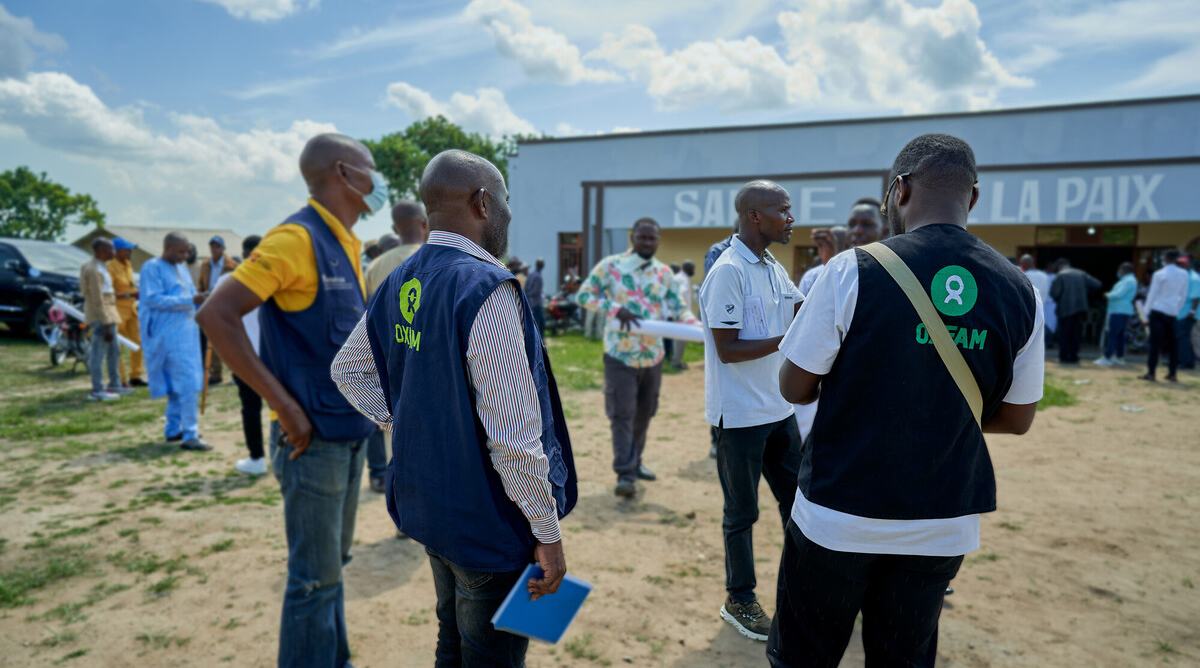
Photo: Tshipson Tshipalaba/Oxfam

Ebola response kit

Oxfam is setting up and distributing water, sanitation, and hygiene (WASH) kit supplies in Ituri, the location at the centre of the Ebola outbreak in the DRC.

Supplies include:

  • infrared thermometers
  • handwashing buckets
  • pouch disinfectants for personal use
  • office disinfectants

How your donations will help people affected by the Ebola outbreak

Without urgent, decisive action, this outbreak could become one of the deadliest on record. Ongoing conflict, limited healthcare capacity, cross-border spread, and cuts to global aid are all making the situation worse.

Right now, funding falls far short of what’s needed. Immediate support is essential to slow the spread, strengthen our response, and protect vulnerable communities from a much larger crisis.

By donating to our DRC Crisis Appeal, you can help Oxfam and our partners scale up life-saving prevention work and stop the outbreak from becoming even more severe.

In Bunia, Oxfam’s Public Health Team Leader Roger Kalimira describes how the organisation is supporting communities affected by Ebola, with a focus on water, hygiene and sanitation.

What's happening in the Democratic Republic of Congo?

  • In May 2026, the World Health Organization (WHO) declared an Ebola outbreak in eastern Democratic Republic of Congo (DRC).
  • Millions of people are already in urgent need of humanitarian assistance, due to ongoing fighting around the city of Goma and across North and South Kivu in the DRC.
  • Over 7 million people have been displaced and left without shelter, food or water. More than half of those are women and children.
  • Thousands of men, women and children have fled into neighbouring Burundi in search of safety.
  • The fighting has forced people to leave the displacement camps in Goma, many of which were destroyed or looted.
  • Communities are struggling to access cash to buy food or return home as banks in Goma remain closed.
  • Women and girls are among the most at risk from gender-based violence.
  • Aid cuts are having a devastating impact on communities that depend on humanitarian aid for survival.

This [Ebola] outbreak is hitting a country already stretched to breaking point. Ongoing conflict and years of aid cuts have deepened a humanitarian crisis of staggering scale: one in four people are going hungry. Those same aid cuts left DRC effectively exposed to Ebola, weakening the surveillance systems that should have detected this outbreak weeks earlier.”

Dr. Manenji Mangundu, Oxfam Country Director in the DRC

Support people affected by the ongoing crisis

What is Oxfam doing in the Democratic Republic of Congo?

People face a lack of basic essentials but the violence and scale of need is making it extremely difficult to reach people.

Together with partners, Oxfam is continuing to provide people with clean water and basic essentials to those affected by the conflict. Oxfam is working to restore critical infrastructure and treat septic tanks to help provide water and sanitation to affected communities.

Without adequate shelter and access to critical resources, the risk of disease outbreaks, is a real threat.

Oxfam has worked in DRC since 1961 and currently operates in several provinces including Equateur, North Kivu and South Kivu.

Millions of people have already been forced to flee their homes in the Democratic Republic of Congo because of ongoing armed conflict. More than 25 million people are in need of humanitarian assistance. Conflict, Mpox virus, Ebola and cholera outbreaks have already claimed countless lives in the country.

Please donate what you can today to help us scale up our response.

How we spend your donation

For every £1 you donate to this emergency appeal, we will allocate 9p of your donation to cover general support and running costs. There is a small chance that we will raise more money than is needed for this appeal. If this happens, we’ll spend any additional funds on other Oxfam projects – wherever the need is greatest.