Oxfam
Footprints of poorest half the population set to remain well below this limit
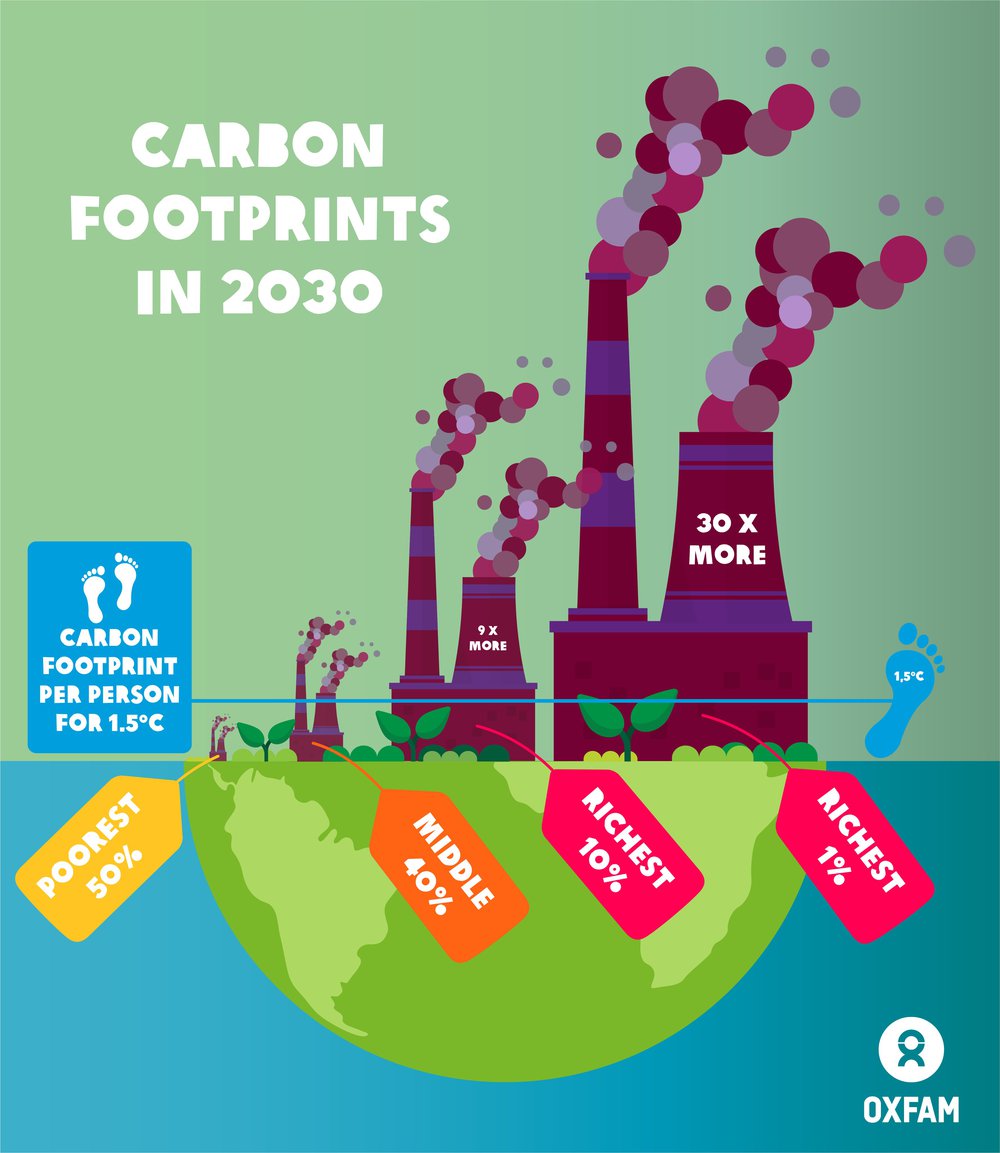
The carbon footprints of the world’s richest 1% are set to be 30 times greater than the level compatible with the 1.5°C goal of the Paris Agreement in 2030, according to a new report published today. It comes as delegates grapple with how to keep this goal alive at the COP26 meeting in Glasgow.
In 2015, governments agreed to the goal of limiting global heating to 1.5°C above pre-industrial levels, but current pledges to reduce emissions fall far short of what is needed. To stay within this guardrail, every person on Earth would need to emit an average of just 2.3 tonnes of CO2 per year by 2030 – this is roughly half the average footprint of every person today.
Today’s report, commissioned by Oxfam based on research carried out by the Institute for European Environmental Policy (IEEP) and the Stockholm Environment Institute (SEI), estimates how governments’ pledges will affect the carbon footprints of richer and poorer people around the world. It treats the global population and income groups as if they were a single country. It finds that by 2030:
- The poorest half of the global population will still emit far below the 1.5°C-aligned level in 2030.
- The richest 1% and 10% of people are set to exceed this level by 30 times and nine times respectively.
- Someone in the richest 1% would need to reduce their emissions by around 97 per cent compared with today to reach this level.
But in a sign that the 2015 Paris Agreement is having some impact, the middle 40 per cent are on course for per capita emissions cuts of nine per cent from 2015 to 2030. This is a turnaround for a group, which is mostly made up of citizens in middle-income countries like China and South Africa that saw the fastest per capita emissions growth rates from 1990 to 2015.
Looking at total global emissions, instead of per capita emissions, the richest 1% – fewer people than the population of Germany - are expected to account for 16 per cent of total global emissions by 2030, up from 13 per cent in 1990 and 15 per cent in 2015. The total emissions of the richest 10% alone are set to exceed the 1.5°C-aligned level in 2030, regardless of what the other 90 per cent do.
Nafkote Dabi, Climate Policy Lead at Oxfam, said: “The emissions from a single billionaire space flight would exceed the lifetime emissions of someone in the poorest billion people on Earth. A tiny elite appear to have a free pass to pollute. Their over-sized emissions are fuelling extreme weather around the world and jeopardising the international goal of limiting global heating. The emissions of the wealthiest 10% alone could send us beyond the agreed limit in the next nine years. This would have catastrophic results for some of the most vulnerable people on Earth who are already facing deadly storms, hunger and destitution.”
The geography of global carbon inequality is set to change too, with a larger share of the emissions of the world’s richest 1% and 10% linked to citizens in middle income countries. By 2030, Chinese citizens will be responsible for almost a quarter (23 per cent) of the emissions of the richest 1%, US citizens for a fifth (19 per cent) and Indian citizens for a tenth (11 per cent).
Tim Gore, author of the report and Head of the Low Carbon and Circular Economy programme at IEEP, said: “The global emissions gap to keep the 1.5°C Paris goal alive is not the result of the consumption of most of the world’s people: it reflects instead the excessive emissions of just the richest citizens on the planet. To close the emissions gap by 2030, it is necessary for governments to target measures at their richest, highest emitters – the climate and inequality crises should be tackled together. That includes both measures to constrain luxury carbon consumption like mega yachts, private jets and space travel, and to curb climate-intensive investments like stock-holdings in fossil fuel industries.”
Emily Ghosh, Scientist at Stockholm Environment Institute says: “Our research highlights the challenge of ensuring a more equitable distribution of the remaining and rapidly diminishing global carbon budget. If we continue on the same trajectory as today the stark inequalities in income and emissions across the global population will remain, challenging the equity principle at the very heart of the Paris Agreement. Analysis of carbon inequality must urgently be put at the centre of governments efforts to reduce emissions.”
Oxfam said world leaders should focus on targeting deeper emissions cuts by 2030, in line with their fair share, and ensure that the richest people worldwide and within countries make the most radical cuts. The richest citizens have the potential to speed up this process dramatically, both by leading greener lifestyles but also by directing their political influence and investments towards a low-carbon economy.
Ends
Notes to editors:
For more information, interview requests please contact:
- Kai Tabacek, Oxfam – ktabacek1@oxfam.org.uk / +44 (0)7584 265 077 or
- Sophie Bowell, Oxfam – sbowell@oxfam.org.uk / +44 (0) 7810 814 980
- Sarah Pepinster, IEEP - spepinster@ieep.eu
The report was commissioned by Oxfam and authored by Tim Gore, IEEP, based on research carried out by IEEP and SEI.
The briefing can be found here: Carbon Inequality in 2030: Per capita consumption emissions and the 1.5C goal,
The researchers involved in this study will be available for a virtual Q&A at 2pm GMT on Thursday 4 November. Spaces are limited. Please register for a place: https://us06web.zoom.us/meeting/register/tZAtdO6trz4vH9MLR3hUR4NtWLtyb0t4mBFD
Today’s briefing is based on an analysis of the impact of unconditional Nationally Determined Contributions (NDCs) submitted up to September 2021 under the Paris Agreement on the per capita consumption emissions of different global income groups.
Global income groups
- Richest 1%
Estimated consumption emissions per person in 2030 (tonnes CO2 per year) - 70
Number of times over the level of per capita emissions consistent with 1.5°C (2.3 tonnes) x30
- Richest 10%
Estimated consumption emissions per person in 2030 (tonnes CO2 per year) 21
Number of times over the level of per capita emissions consistent with 1.5°C (2.3 tonnes) x9
- Middle 40%
Estimated consumption emissions per person in 2030 (tonnes CO2 per year) 5
Number of times over the level of per capita emissions consistent with 1.5°C (2.3 tonnes) x2
- Poorest 50%
Estimated consumption emissions per person in 2030 (tonnes CO2 per year) 1
Number of times over the level of per capita emissions consistent with 1.5°C (2.3 tonnes) x0.43 (less than half)
The UNEP Emissions Gap Report 2021 estimates that total global emissions will need to fall to approximately 18 Gt CO2 (25 Gt CO2e) per year by 2030, on a pathway to net zero emissions by mid-century, in order to have a reasonable chance of limiting global heating to 1.5°C. This works out to approximately 2.3 tonnes CO2 per person per year (per capita emissions) in 2030.
By 2030, the global population is projected to be approximately 7.9 billion people. This will comprise approximately 80 million people in the top 1 per cent, 800 million in the top 10 per cent, 3.4 billion in the ‘middle 40 per cent’ and 4 billion in the poorest 50 per cent.
By 2030, you would need an annual income (expressed in $2011 purchasing power parity) of more than $172,000 to be in the richest 1 per cent; more than $55,000 to be in the richest 10 per cent; more than $9,800 to be in the middle 40 per cent; or less than $9,800 to be in the poorest half of the global population.
This briefing builds on last year’s report from Oxfam and SEI which estimated that the richest 1 per cent of people on Earth is responsible for twice the carbon emissions of the poorest 50 per cent from 1990 to 2015.
Carbon emissions per passenger for an 11-minute space flight are estimated to be at least 75 tonnes, according to a recent report by Lucas Chancel. People in the poorest billion emit less than one tonne of carbon per year.
The Institute for European Environmental Policy (IEEP) is a sustainability Think Tank working with stakeholders across EU institutions, international bodies, academia, civil society and industry. Our team of economists, scientists and lawyers produce evidence-based research and policy insight (www.ieep.eu).
The Stockholm Environment Institute is an international non-profit research and policy organization that tackles environment and development challenges.
Press contact
For comments, interviews, or information please contact the Oxfam GB Media Team:
- Landline: +44 7748 761999
- Mobile: +44 7748 761999
- Email: media.unit@oxfam.org.uk