UK must use UN Presidency to show commitment to principle of ‘leave no-one behind’

• Published:
• Short URL: https://www.oxfam.org.uk/mc/tisuf7/

Humanitarian support for the world’s most vulnerable people is a valid projection of geopolitical power and influence. The UK’s Presidency of the United Nations Security Council in February 2026 is a real opportunity to demonstrate the ability of the UN and a multilateral approach towards protecting civilians, ending violence and addressing impunity and violations of international law. This is the best opportunity for the UK to show global leadership in 2026.

Sudan hosts the world’s largest humanitarian crisis, and we’re now seeing that the 2025 cuts to international aid are now having a disastrous impact for the millions of people already grappling with extreme hunger and disease. Where I work in Renk, South Sudan, a vital transit hub for displaced persons, due to cuts Oxfam are now reaching 92 per cent fewer people than last year. The UK and international community must remember that it has the capacity and agency to respond to this dire humanitarian situation, and thus avert an even greater regional catastrophe.”

Shabnam Baloch, Oxfam South Sudan’s Country Director

Oxfam calls for:

  • The UK Government to use its upcoming Presidency of the UN Security Council to position the UK at the forefront of diplomatic efforts to break international paralysis and to put an end to the widespread suffering of civilians, stabilise the region and address impunity and gross violations of international law.
  • The UK Government to increase  its humanitarian commitment to enable a principled and effective  humanitarian response that meets the  large scale and immediate needs of populations inside Sudan and across the border in South Sudan and Chad where Sudanese are fleeing extreme violence and human rights violations.
  • The UK Government to develop and implement an approach that strengthens stability across the region, with increased funding to tackle key issues such as cross-border access, protection and conflict prevention.
  • The UK Government to scale up effective international support to frontline responders and national and local aid workers and local emergency responders while also strengthening its investment in civic space.

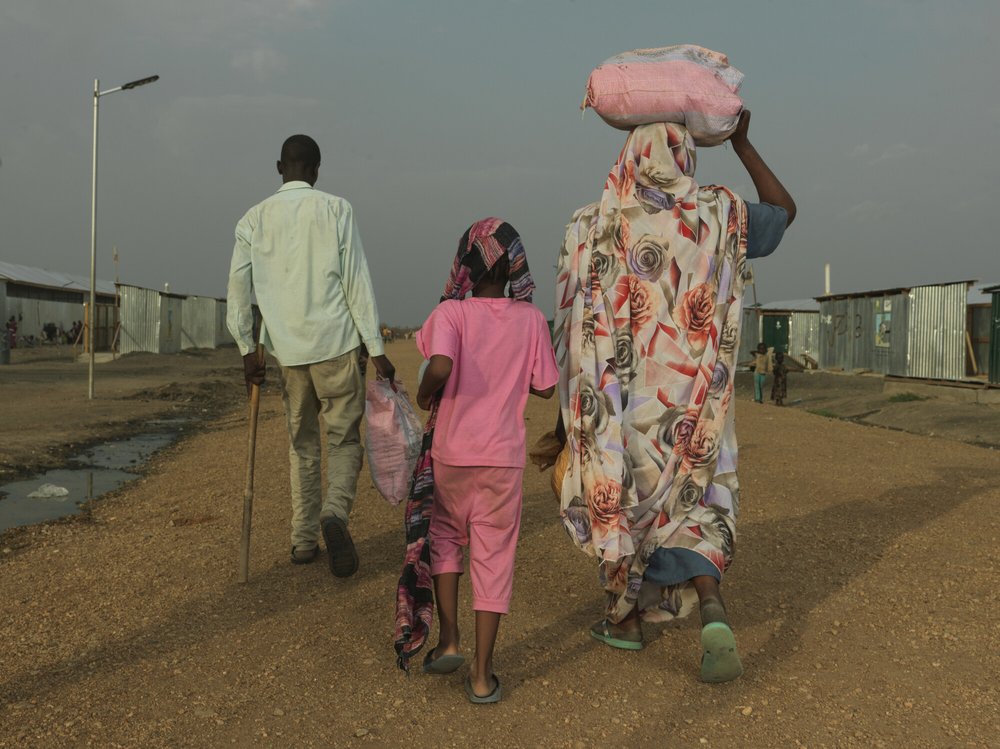
Peter Caton/Oxfam

A family of three walking away from the camera in a transit centre in South Sudan

Khamis Adam Mohammed, 33, and his family arrive at the transit centre in Renk after arriving from war torn Sudan.

Over the last two years the civil war in Sudan has killed more than 150,000 people, created a famine in western Darfur, and about 12 million people have fled their homes. It is the world's largest humanitarian crisis.

Despite its own struggles, South Sudan has not closed its borders. Communities continue to welcome those fleeing violence, even as resources dwindle, and support becomes painfully thin. South Sudan faces unprecedented challenges: conflict, displacement, food insecurity, and worsening climate shocks. Two-thirds of the population - ten million people – require humanitarian assistance. Any reduction of support now risks reversing hard-won progress and leaving millions without hope. With Sudan entering a critical phase of mass hunger, expanding conflict (particularly with the onset of the dry season) and immediate threats posed to civilians across Darfus and Kordofan, the UK and international community must remember that it has the capacity and agency to respond to this dire humanitarian situation, and thus avert an even greater regional catastrophe.

Press contact

For comments, interviews, or information please contact the Oxfam GB Media Team: