Unmasking Aden: The Hidden Realities of a City Battling Climate Change
• Published:
• Short URL: https://www.oxfam.org.uk/mc/pkojso/
With its blue skies, shimmering sea, and sun-bleached buildings, Aden is a city that holds a thousand stories. Known for its beauty, hospitality, and resilience, it has weathered countless storms, but perhaps none as brutal and relentless as the one it faces today.
By Nada Alsaqaf & Fatma Jaffar
Aden is a port city located in Yemen in the southern part of the Arabian Peninsula, on the north coast of the Gulf of Aden, positioned near the eastern approach to the Red Sea. With a strategic location, the city plays a pivotal role in facilitating commerce between continents.
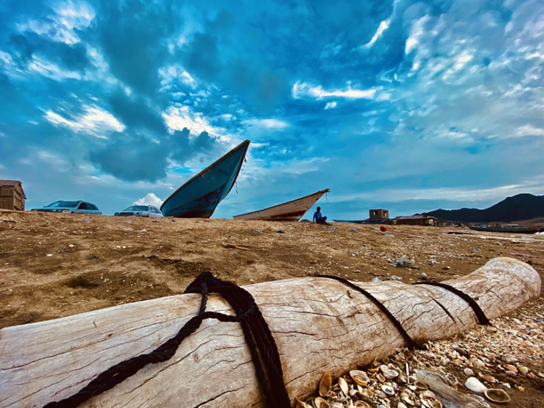
Albraiqa, Aden. Photo credit: Nada Alsaqaf
Dangerous Waters
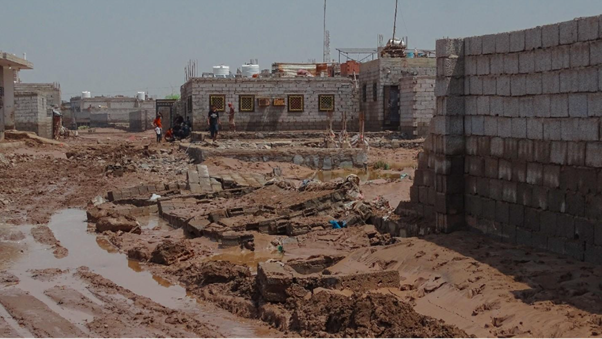
Yemen is highly vulnerable to climate related impacts that have worsened over the years and particularly affected coastal areas like Aden. In August 2025, heavy rains and flooding devastated large areas of the city. The streets of Tawahi, Mualla, Al-Hiswah, and Al-Buraiqah turned into rivers. Families climbed onto rooftops, waiting for hours to be rescued, while floodwaters mixed with sewage spread across entire neighbourhoods. Schools filled overnight with displaced families.
The destruction was catastrophic. According to the Executive Unit for IDPs, more than 5,399 shelters were destroyed and nearly 2,000 partially damaged in Aden alone. Over 5,300 displaced families were left urgently needing food, shelter, and clean water. The damage was so severe that local authorities declared Al-Buraiqah district a disaster zone.
A mother from Al-Buraiqah told me:
“We climbed to the rooftop and waited for hours to be rescued. From above, we watched the water swallow the neighbourhood. I kept asking myself: how will I replace everything we lost? What will I feed my children tomorrow?”
For many in Aden, survival now means rebuilding lives that were washed away in a single night.
A Double Struggle: Poverty and Climate Change
In Yemen, the phrase "climate change" might be considered abstract - a distant, academic idea for a population already fighting for food, shelter, and peace. But in Aden, its impact is brutally evident. Al-Buraiqah - once a natural flood channel - has become a crowded residential district. With every storm, streets collapse, sewage mixes with floodwaters, and families are forced to flee.
And these floods are not isolated events. Climate change is amplifying Aden’s vulnerabilities, making rains more intense, seas higher, and heatwaves longer. Despite the resilience of Adeni people, every flood adds another layer to their fragility.
Voices from the Frontlines
Issa, 31, described torrents of water crashing into his home, carrying rocks and mud with it:
“We felt the house would collapse on us. The children were terrified.”
Sam, 21:
“The water destroyed everything - even our official documents. We live hand-to-mouth and cannot recover these losses.”
These voices and their stories echo across the city. People who were already vulnerable are now standing amid rubble, staring at what used to be their homes.
am standing in front of his home, Al Qaluaa, Aden. Photo credit: Abdulbari Othman/Augest2025
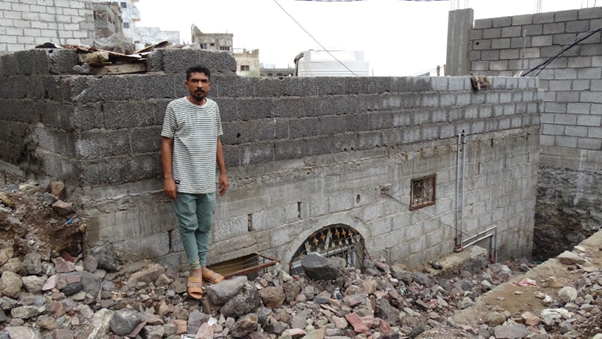
Sam standing in front of his home, AlQaluaa, Aden. Photo credit: Abdulbari Othman/August 2025
A City on the Brink
Aden, poised on the edge of the Arabian Sea, is drowning in the very waters that once gave it life. Sea-level rises threaten its shores, bringing with it erosion, flooding, and saltwater intrusion. The infrastructure groans under the weight of an aging sewage system.
The arrival of seasonal rains often brings as many risks as it does relief. Without proper drainage systems, neighbourhoods quickly flood, damaging homes, cutting off electricity and water, and leaving communities vulnerable to outbreaks of cholera and dengue.
Informal settlements, already fragile, face the highest risk of collapse and displacement. What Aden needs is not only stronger infrastructure to channel rainwater safely, but also effective emergency planning, early warning systems, and close coordination between authorities and communities. Preparing in this way can transform rain from a recurring disaster into a manageable challenge.
"The situation is tragic. Since 2015, government initiatives have stopped, leaving the city vulnerable to an impending disaster."
Jameel Al-Qudsi
Director General of Environmental Emergencies
"Some climate studies predict a rise in sea levels that will affect several low-lying areas and Yemeni coasts, including the city of Aden - which, according to forecasts, is among the ten cities most threatened by climate change and rising sea levels. In some parts of Aden, the elevation ranges between 60–70 centimeters above sea level. If these scientific predictions prove true, these areas will be at serious risk. The Khor Maksar district is among the areas included in the study, which could lead to major economic losses. Infrastructure planning must take into account the construction of sea barriers and breakwaters and their elevation in line with these projections."
Abdulhakim Al-Alaya
Deputy Minister for the Environment Sector
"We need to support national institutions so they can become resilient and prepared to face natural disasters, and to develop policies that align with international approaches while adopting flexible measures to reduce disaster risks."
Abdulhakim Al-Alaya
Deputy Minister for the Environment Sector
"To reduce natural disasters, we start by developing scientific knowledge about disasters and analyzing their risks. This forms the foundation of disaster prevention. Through this, we can identify the likelihood of natural disasters, their locations, and timing. It also allows us to assess potential hazards and threats from natural events, identify vulnerabilities, and determine available capacities and measures to help plan and implement disaster risk prevention strategies. Efforts should focus on reducing natural disaster risks through strengthening infrastructure, raising public awareness about potential disasters through media and other available means, as well as conducting training, capacity building, and developing volunteer work.
“Preparedness and readiness to face disasters involve all sectors of the state and society to enhance the level of response by ensuring logistical and organizational measures are in place even before a disaster occurs. This includes having emergency plans, conducting evacuation, rescue, and shelter drills, improving early warning systems, and managing and storing relief supplies, including training people in first aid.
“Urban planning and preventing people from building in flood-prone areas or along flood channels are crucial measures to mitigate the impacts of disasters. But all this requires enforcing strict legislation and laws."
Abdulhakim Al-Alaya
Deputy Minister for the Environment Sector
“Despite our efforts, we lack the resources needed to mitigate the severity of disasters or to take necessary precautions. What we are doing now is protecting what already exists."
— Jameel Al-Qudsi, Director General of Environmental Emergencies
These words echo a reality Aden knows all too well: without investment in preparedness, every storm becomes a catastrophe.
The Fisherman and the Friend He’s Losing
Salah, a 54-year-old fisherman, welcomed us with a weathered smile as warm as the sea breeze. “The beach is my friend,” he said. “Not just my livelihood, but my heart.”
He remembers skipping school to dive off his father's boat. But now, the fish are fewer, the waters warmer, and the ocean - his friend - is suffering. "It hurts,” he whispered. “To see the sea sick. And we are getting sick with it.”
Salah in his boat in Alburiqa, Aden. Photo credit: Nada Alsaqaf
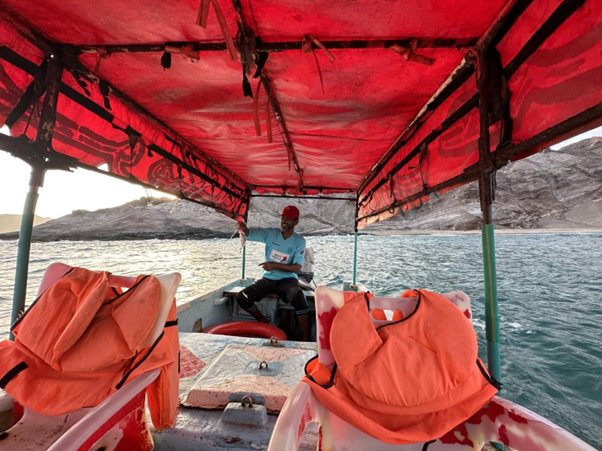
Salah in his boat in Alburiqa, Aden. Photo credit: Nada Alsaqaf
Oxfam’s Lifeline: Wastewater Rehabilitation in Aden
In the heart of Aden, where untreated wastewater had been flowing into the sea since 2007, a transformative project has taken shape. With support from the German Federal Ministry for Economic Cooperation and Development (BMZ) and led by Oxfam, the Aden Wastewater Network Rehabilitation Project targeted four key districts — Khormaksar, Sirah, Al-Ma’alla, and Attawahi — to revive and modernize vital sanitation infrastructure.
Now, for the first time in over a decade, wastewater is safely treated, pollution has been significantly reduced, and residents are beginning to breathe cleaner air. This project not only protects the sea, it protects lives, restores dignity, and builds a healthier, more sustainable future for Aden.
The Tide Can Still Turn
Despite everything, Adeni people continue to show extraordinary resilience. But resilience alone cannot carry the weight of climate change, poverty, and conflict forever. While people endure, they are also vulnerable - each disaster adding another layer of suffering.
This has been more than reporting. It has been a journey to understand Aden’s truth - from the rooftops of Al-Buraiqah, to government offices, to the sea where Salah mourns his friend, the ocean. Each voice carried the same plea: Aden is resilient, but without urgent action, resilience alone will not be enough.
We owe it to every mother who waits on a rooftop, to every child who dreams by the water, to every fisherman who watches his sea grow sick. We owe it to Aden itself.
With every effort - local, national, and global - Aden can rise from these waters. Its people have not given up. Neither should we. The tide can still turn, but only if we act now - before the next flood.
Press contact
For comments, interviews, or information please contact the Oxfam GB Media Team:
- Landline: +44 7748 761999
- Mobile: +44 7748 761999
- Email: media.unit@oxfam.org.uk