What's happening in the West Bank?

Last updated: 10 April 2026

Latest updates from the West Bank

What is the West Bank?
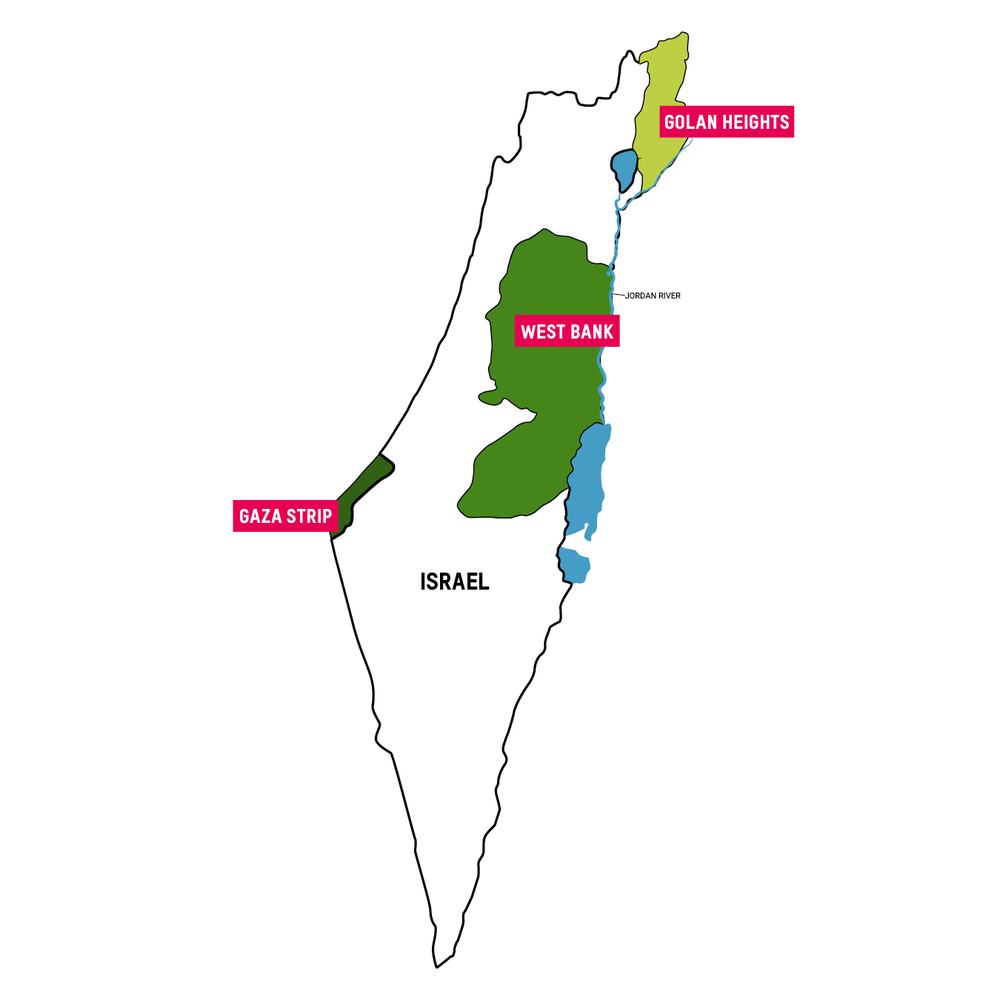
The West Bank, including East Jerusalem, is part of the Palestinian territory.

It’s on the western bank of the Jordan River, where it gets its name.

After the six-day war in 1967, Israel occupied the West Bank, including East Jerusalem, Gaza, and additionally the Syrian Golan Heights and Shabaa farms. All remain under Israel's unlawful military occupation.

How big is the West Bank?

The West Bank is about fifteen times the size of the Gaza Strip. That’s about half the size of Northern Ireland.

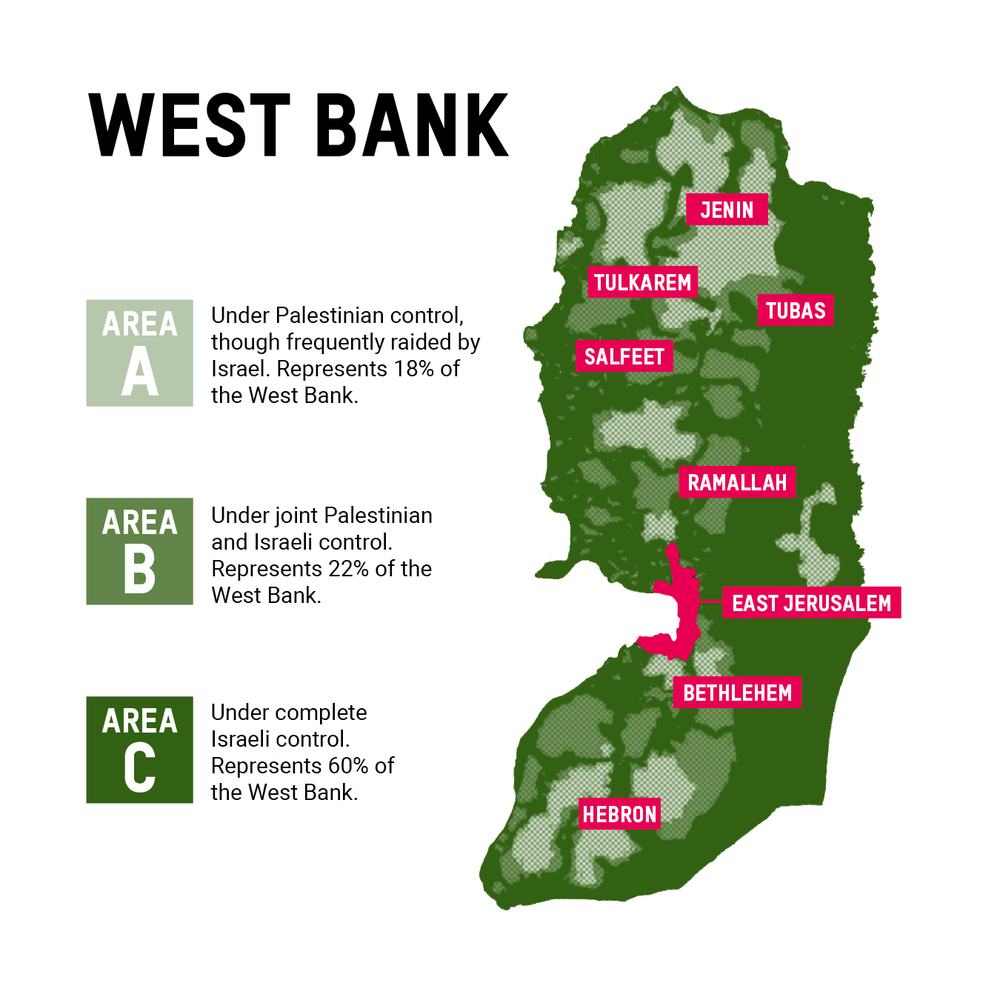
After the Oslo agreements, which never came to full fruition, the West Bank was split into three areas – A, B, and C.

  • Area A is under Palestinian control and makes up just 18% of the West Bank. It is raided frequently by Israeli forces.
  • Area B is under joint Israeli/Palestinian control and makes up 22% of the West Bank. Palestinians are in charge of education, health and the economy. But Israeli forces have control of security meaning they retain the alleged right to enter at any time.
  • Area C is entirely under Israeli control and makes up 60% of the West Bank. It is where most Israeli settlers live. It holds most of the West Bank’s natural resources, including its fertile agricultural land.

Who lives in the West Bank?

The West Bank is home to 3.3 million Palestinians.

As a result of being forced out of their homes by Israeli settlers, around 25% of Palestinians in the West Bank live in refugee camps.

Who are settlers?

Settlers are Israeli citizens who live illegally on Palestinian land in the occupied West Bank and East Jerusalem.

More than 700,000 Israelis are living illegally in settlements that occupy 42% of the West Bank.

What is a settlement?

An Israeli settlement is a town or city built illegally on Palestinian land, exclusively for Israeli settlers.

Settlements play a major role in Israel’s unlawful occupation of Palestine, enabling them to capture gradually more and more land.

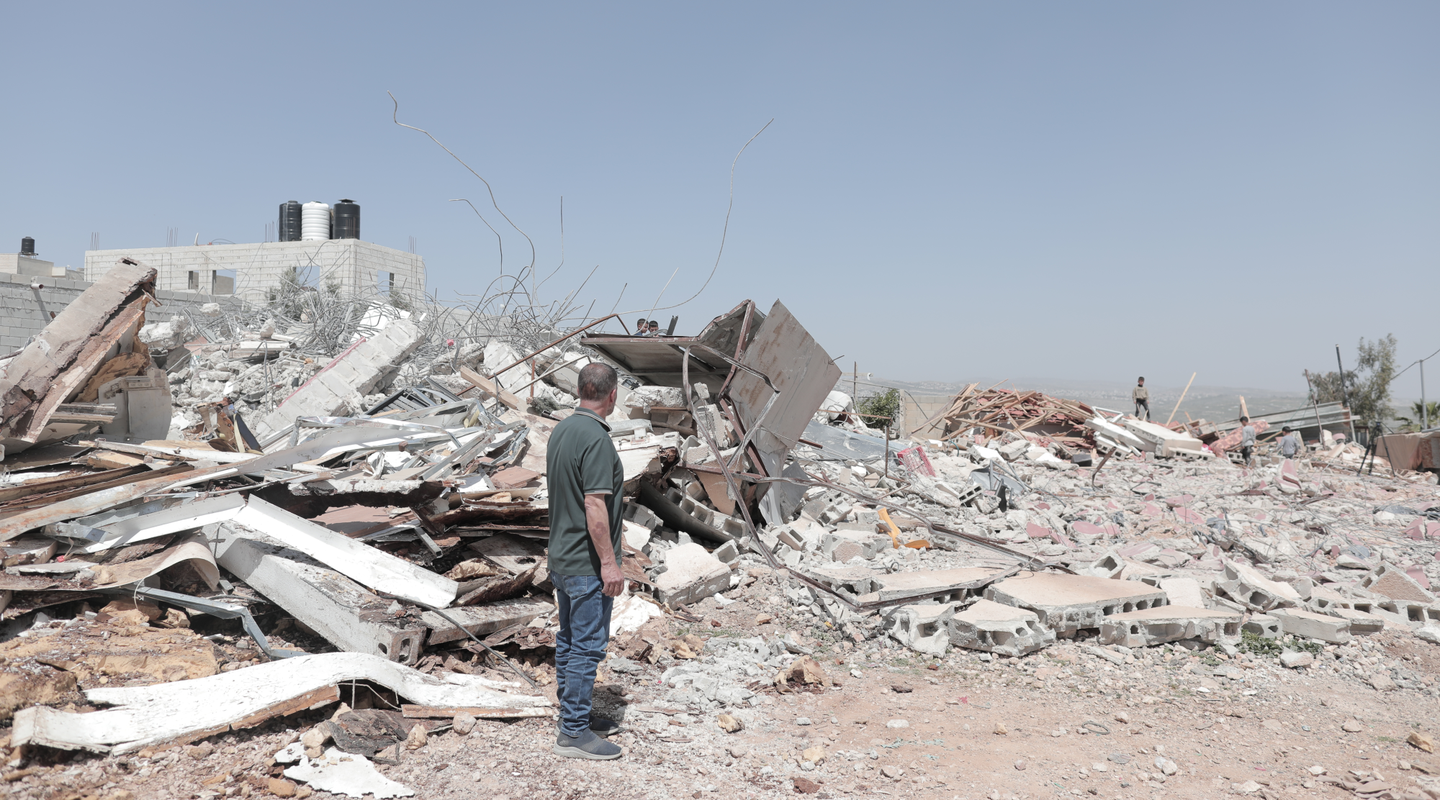
Building a settlement involves the forcible and violent displacement of Palestinians, as well as the demolition of their homes, and destruction of farmland and infrastructure.

Settlements often begin as ‘outposts’ built by Israeli settlers without formal authorisation from Israel.

However, the Israeli government has historically retrospectively 'legalised’ these outposts, and then normally provides funding and infrastructure.

Are Israeli settlements legal?

No. The International Court of Justice (ICJ) and successive UN resolutions have found Israeli settlements to be illegal under international law.

Yet, several Israeli laws enable citizens to build on Palestinian land. The Israeli government enables settlements and has openly approved plans to build illegal settlements in the West Bank.

How many Israeli settlements are in the West Bank? 

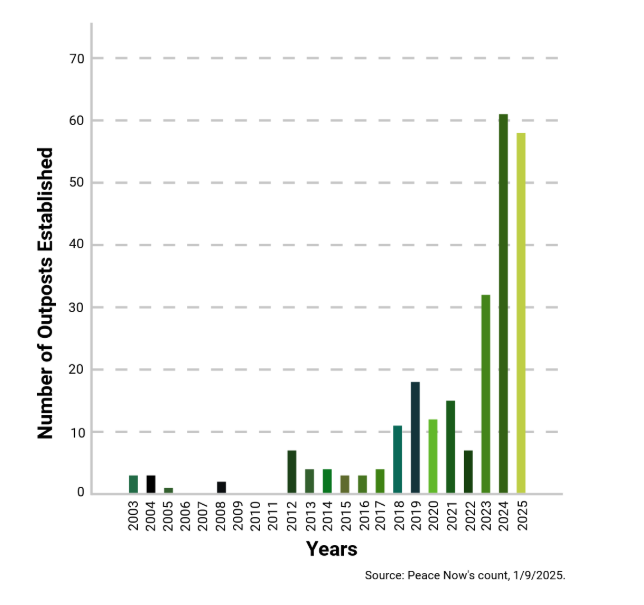
The UN demanded Israel dismantle its settlements by September 2025. Instead, settlement activity has increased:

  • There are 141 settlements in the West Bank
  • There are 224 outposts in the West Bank
  • 151 new outposts have been established since 2023

Source: https://peacenow.org.il/en/settlements-watch/settlements-data/population .

What's it like living in the West Bank?

Israel’s occupation impacts every aspect of life for Palestinians in the West Bank, including East Jerusalem.

Palestinians are subjected to a total denial of their right to self-determination and sovereignty.

Freedom of movement

  • Israel controls all access into the West Bank, and Palestinians living there face severe restrictions on movement. The West Bank is separated from Gaza, and Palestinians are not permitted to travel between the two.
  • In 2002, the Israeli authorities built an illegal separation wall between the West Bank and Israel, effectively annexing a further 9% of Palestinian land, and separating East Jerusalem from the rest of the West Bank.
  • There are almost 900 military checkpoints and roadblocks throughout the West Bank, making travel difficult, time-consuming, and dangerous. They restrict Palestinians’ ability to work, socialise and access essential services like medical care.
  • Massive infrastructure has been built to support Israeli settlements, including bypass roads and rail systems – but Palestinians are not permitted to use these.

Legal system

  • Palestinians are subjected to a separate and discriminatory legal system run by the Israeli military.
  • Palestinians are systematically denied their basic rights, and sentenced in separate military courts with a 99.7% conviction rate.
  • Israel holds more than nine thousand Palestinians in its jails – many unlawfully and indefinitely without charge or trial. They are subject to inhumane conditions, starvation and torture as state policy.
  • Palestinian communities also face routine military raids, arbitrary arrest, and collective punishment measures that impact entire families.

Settler violence 

  • Settler violence is systemic and widespread. It can include armed violence and killings, destruction of farmland, and harassment. These attacks devastate Palestinian communities and cause many people to flee.
  • But settler violence is rarely investigated by the Israeli authorities. In many cases, Israeli soldiers are present during their attacks to support and protect settlers.
  • Since 2005, only 3% of investigations into acts of settler violence against Palestinians in the West Bank has led to a full or partial conviction.
  • Settler violence is unofficially enabled by the Israeli authorities because it allows them to take over more Palestinian land without the need for military action or direct state implication.

Access to resources

Confiscation of agricultural land

  • Israeli authorities and settlers routinely seize agricultural lands from Palestinian farmers to make space for further settlement expansion, for conversion into military sites, and to establish pastoral settlements for Israeli shepherds to raise and graze livestock.
  • In the process they destroy crops and contaminate the land with waste and sewage.
  • Palestinian farmers are routinely denied access to their agricultural and grazing lands near settlements.
  • Since 1967, over 800,000 olive trees have been uprooted, vandalised or destroyed by Israeli forces and settlers. This is particularly significant as olive-related trade accounts for roughly 14% of the entire Palestinian economy, and is a cornerstone of Palestinian heritage and a lifeline for thousands of families.

What are the consequences for the Palestinian economy?

Israel’s occupation and settlement project has fragmented the West Bank and destroyed the Palestinian economy.

Israeli authorities exercise near complete control over the Palestinian economy and trade policies. They have stifled Palestinian industry, and driven long-term economic devastation, widespread unemployment and poverty, by:

  • confiscating productive land
  • blocking the movement of goods
  • severing supply chains
  • preventing access to local and foreign markets
  • restricting the movement of workers.

The World Bank estimates that these restrictions cost the Palestinian economy billions of dollars every year. This has resulted in de-development in the occupied Palestinian territory.

The settlement economy

These same restrictions do not apply to companies based in illegal Israeli settlements. Along with other incentives from the Israeli government, this ensures that products made in settlements are artificially cheaper.

This effectively forces low-income Palestinians to buy goods from, and seek insecure work in, illegal settlements.

What needs to happen now?

The International Court of Justice (ICJ) ruled in 2024 that states must not aid or assist Israel in its unlawful occupation of Palestinian territory, including through economic or trade dealings.

Our government must act beyond the symbolic recognition of Palestine and towards true, meaningful statehood for Palestinians: full self-determination, economic sovereignty and an end to brutal occupation.

This includes complying with international law and using its influence and leverage with the Israeli government. The UK must end all arms sales and military support to Israel, and end all trade with illegal Israeli settlements in occupied Palestinian territory.

Photo credit: Andy Aitchison / Oxfam

Join the Red Line for Palestine

Day after day we have watched atrocities in Palestine unfold on our screens, as the Israeli government crosses red line after red line with impunity.

Yet, the UK government remains complicit by its continued military, economic and diplomatic support of Israel.

We must continue to call for accountability, justice and peace. Now is the time to fight for a fair and just future for Palestine.

Join the campaign

How is Oxfam responding to the situation in Palestine?

Oxfam has worked in the Occupied Palestinian Territory and Israel since the 1950s.

We have supported communities in Gaza, the West Bank and East Jerusalem, to tackle the root causes of conflict, build resilience, and protect people’s rights.

Despite huge obstacles, Oxfam staff and partners are responding as best they can to support communities.