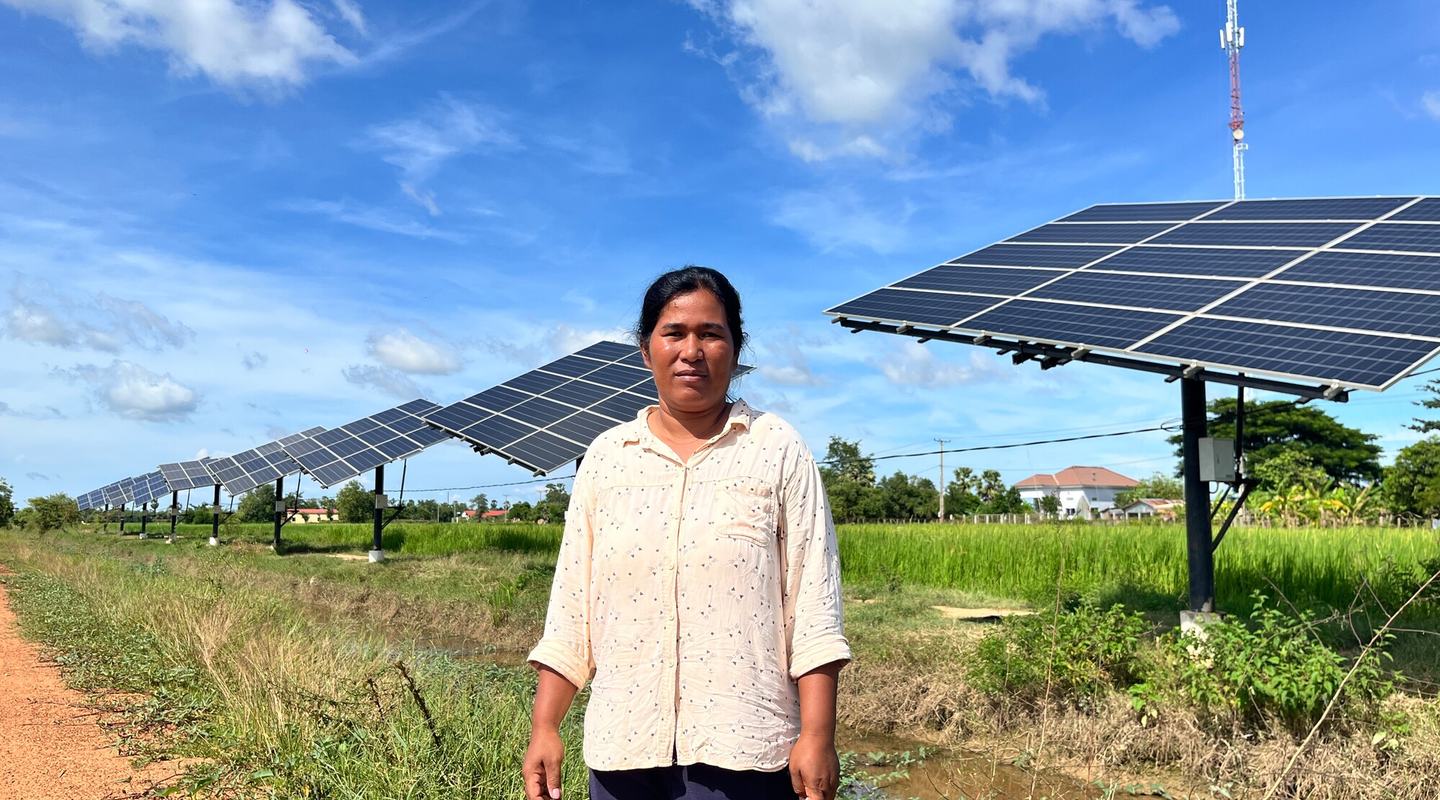
Farmer and system technician Thida in Pursat Province, Cambodia. Credit: Mark Vincent Aranas/Oxfam
Impact stories
Cultivating clean futures in Cambodia
In Cambodia, farming communities once reliant upon diesel power are now cultivating their crops with the support of solar energy.
Since 2010, Cambodia’s electricity demand has increased by about 20% annually, reflecting the country’s rapid economic development and growing energy needs. By 2024, electricity reached 99% of villages nationwide.
However, access to reliable energy is still a daily challenge in rural areas. Many smallholder farmers rely upon diesel pumps to supply water to their fields, which are expensive, polluting, and unreliable.
Mark Vincent Aranas/Oxfam
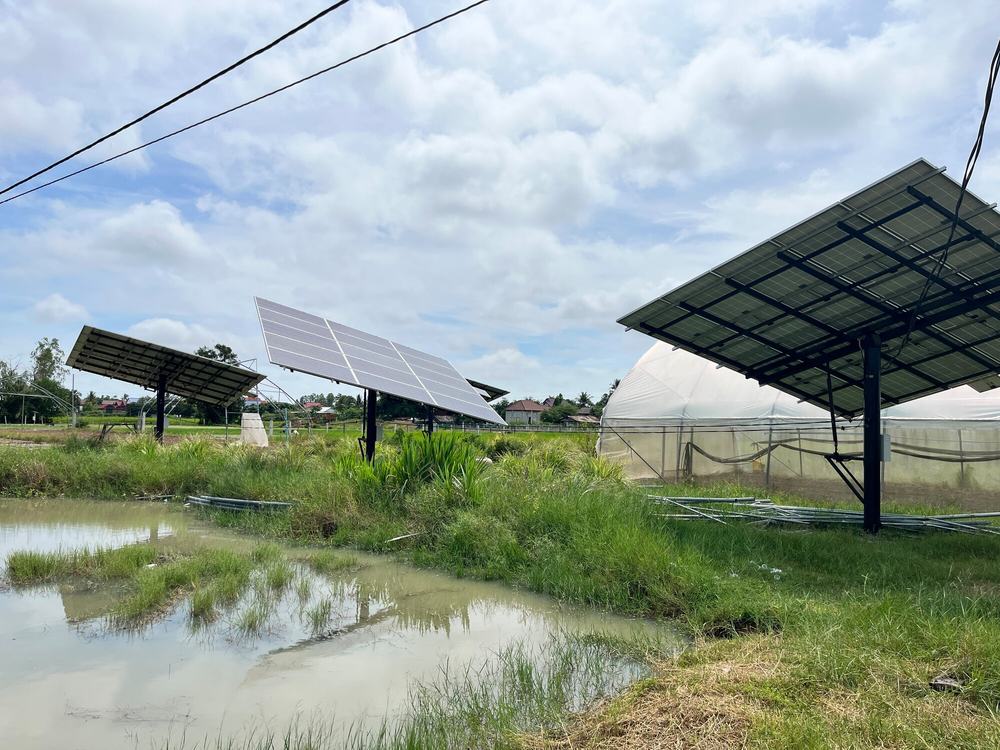
Solar powered pumps in Kampong Chhang, Cambodia.
About Pursat Province
Pursat Province is one of Cambodia's most productive rice-growing regions. However, as rains have become less predictable, irrigation is increasingly necessary to provide water to farmers' fields.
With diesel pumps being so expensive to run, many farmers had to choose between borrowing money or skipping a planting season.
“Before, we couldn’t afford to irrigate much. We depended on the Pursat River, but during the dry season its water level was too low to reach all our fields.”
Thida in Pursat Province, Cambodia.
In 2022, Solar Green Energy Co. alongside Oxfam in Cambodia installed a solar irrigation system in Pursat Province.
Mark Vincent Aranas/Oxfam
The solar irrigation system now serves around 176 farmers across 300 hectares of rice fields, replacing diesel pumps with clean, low-cost solar power.
Ensuring community ownership
To ensure community co-ownership, the system’s management was handed over to a water user group, officially registered under the Provincial Department of Water Resources and Meteorology. Thida was hired as the local technician responsible for the day-to-day operation and monitoring of the solar pumps.
Solar-powered pumps source water from the Pursat River. Credit: Mark Vincent Aranas/Oxfam
This project helped us organize ourselves. Before, everyone just pumped their own water. Now, we plan the irrigation together and make sure everyone gets enough.”
Thida in Pursat Province, Cambodia.
The impact of solar power
The shift to solar power has reduced irrigation costs by nearly 40% per hectare, freeing up income for other farming needs. With reliable, continuous water supply, they can now plant two cropping cycles a year instead of just one.
Farmers now harvest 3 to 5 tons of rice per hectare per season – a significant increase, particularly during the dry months when production used to drop sharply.
“The water comes more regularly now. We used to stay in the fields all day to manage the pumps. Now the committee runs the system; we just follow the schedule.”
Thida in Pursat Province, Cambodia.
This project in Pursat Province is one of many similar initiatives being carried out by Solar Green Energy Co. and Oxfam in Cambodia across the country, reaching over 300 farming families and covering over 550 hectares of farmland.
Oxfam acknowledges the support of the Australian Government through the Australian NGO Cooperation Program (ANCP).