Photo: Spencer Davis from Pixabay.
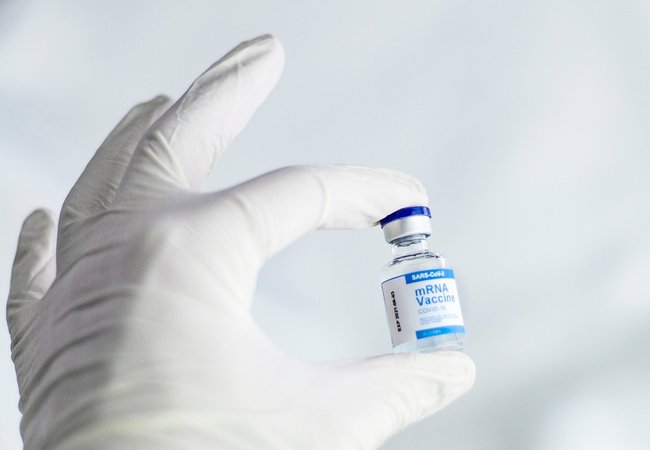
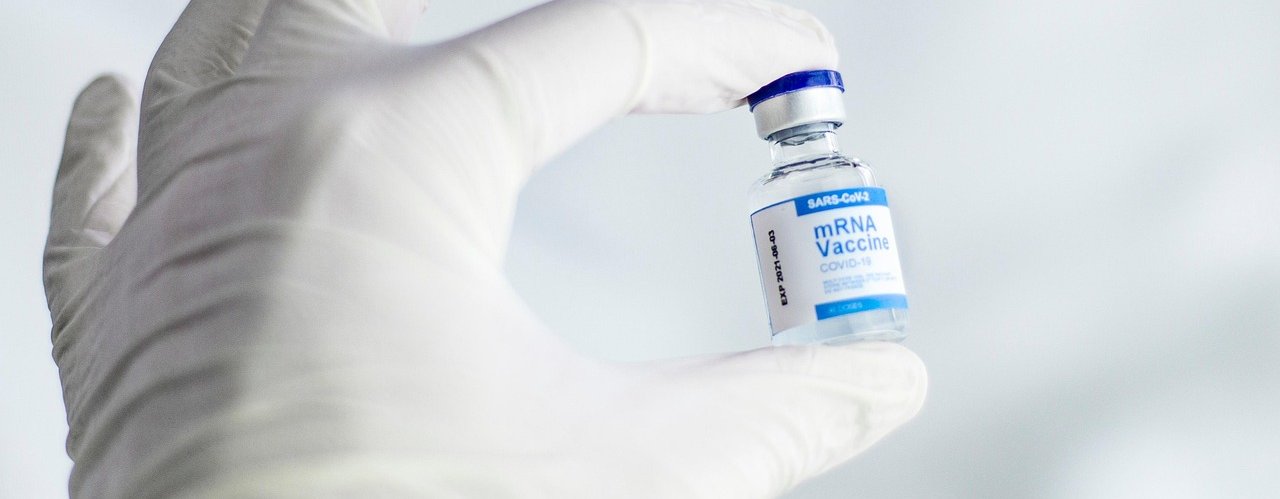
A hand inside a white surgical glove is holding a vial of the mRNA vaccine.

Why did billionaires get richer during Covid-19

Oxfam looks at how the fortunes of the super-rich flourished during the pandemic while businesses closed, people were out of work, the cost of living increased and billions struggled.

The pandemic's unequal impact on wealth

In the informal settlement area of Kawangware in Nairobi, my friend Joe, a nurse, is quarantining in his small room after getting Covid-19 for the second time. He's less concerned about the virus than his finances, which have deteriorated severely in the pandemic, in part due to rising costs of essential services. What infuriates him even more, he says, is media reports of companies' huge profits, including the private hospital chain where he works, even as their workers become poorer. But he's thankful he still has a job as hundreds of thousands of Kenyans lost theirs in the pandemic.

Yet while so many struggle, the richest 0.003% of Kenyans have become richer in the pandemic. According to data from Wealth-X, the wealthiest two Kenyans now own more wealth than the poorest 16.5 million people in the country.

Forbes

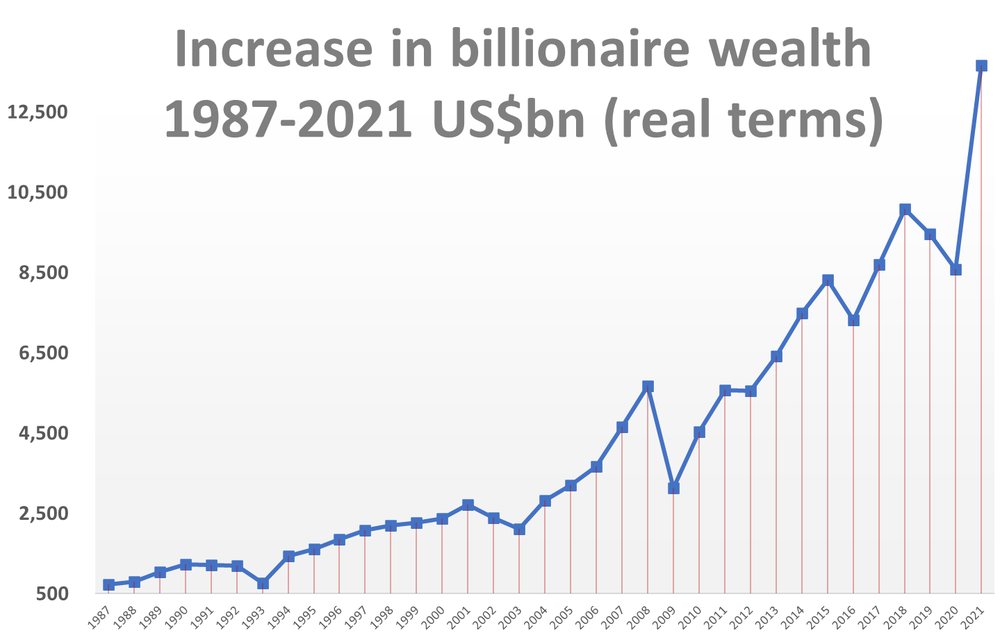
Line graph showing global billionaire wealth rising steadily from 1987 to 2021, with a sharp acceleration from 2020 onwards.

The 'graph of billionaires' rocketing wealth resembles graphs showing the exponential spread of the Omicron variant.

The unequal impact of the pandemic in Kenya has been replicated around the world. In 2021-22 I have been working with Oxfam colleagues on how the past two years have been the best ever for billionaires (see our full report to mark January 2022's online Davos event). The graph of their rocketing wealth resembles graphs showing the rapid spread of the Omicron variant.

Billionaires' wealth soars as inequality deepens

The ten richest billionaires – all men – saw their wealth more than double from $700 billion to $1.5 trillion between March 2020 and November 2021, according to calculations done by Oxfam based on Forbes billionaires. They now own six times more wealth than the poorest 40% of the global population, some 3.1 billion people.

The global billionaire boom during Covid-19

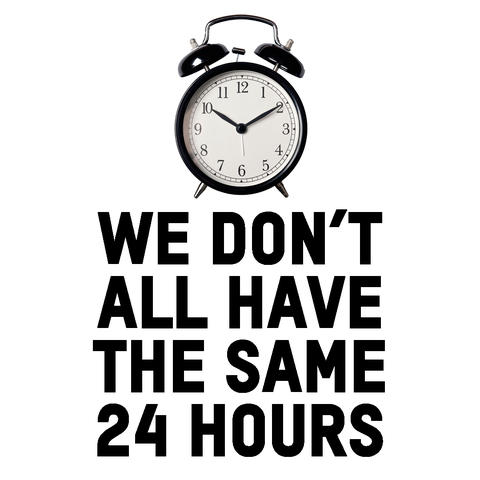
Taken together, billionaires saw their wealth jump by $5.2 trillion to $13.8 trillion between March 2020 and November 2021. This is more than it did in the past 14 years combined. A new billionaire was created every 26 hours. The combined wealth of these 2,660 billionaires is now about the same amount as the whole Chinese economy – the world's second largest.

Meanwhile, the pandemic has battered the world’s poorest. I see that every day in Nairobi. I think of my mother, back home in the village. How can I explain to her the scale of the wealth of these rich people, whilst ordinary people experience extreme poverty?

The world's poor pay the highest price

Everyone has suffered, apart from the super-rich: World Bank figures show 99% of humanity have lower incomes than they would have if Covid-19 had not happened. And 162 million more people are estimated to have been forced into poverty (below $5.50 a day). Variants such as Omicron and the low vaccination rate in some of the poorest countries will only make this worse. Those on the lowest incomes are being hit hardest, particularly women, children and people from communities who already face marginalisation.

America's billionaire surge

It's in the United States where the billionaires had a particularly good time. The world's biggest economy created 126 new billionaires between March 2020 and November 2021, and their wealth increased by an eye-popping $2 trillion. The US government has spent $4.6 trillion to mitigate the pandemic's effects on households and businesses. Yet it seems much of that has gone to the richest few.

How the rich got richer

It's not that those billionaires have worked twice as hard or invested twice as wisely: rather, they have massively benefited from a huge fiscal stimulus by governments: billions of public money has been pumped into the development of vaccines. This government money has driven stocks to record highs, and with it the fortunes of the world’s richest. If the ten wealthiest men were to sit on their combined fortunes piled up in US dollar bills, they would be halfway to the moon.

The pandemic has left a gaping fiscal hole in public finances as governments dished out more than $16 trillion in the past two years to protect businesses and households at a time when revenue shrunk. Public debt is now at historical levels of $226 trillion, or 256% of global GDP.

For the governments to make necessary investment in universal services like health, they need to raise adequate revenues especially from domestic sources and in a progressive way. One obvious way to do this is to make the richest pay more tax through a progressive wealth tax.

Why progressive wealth tax is essential

An annual progressive wealth tax at a rate of 2%, 3% and 5% for the wealth above $5 million, $50 million, and above $1 billion respectively could raise huge amounts, according to calculations done by Oxfam, the Institute of Policy Studies, Fight Inequality Alliance and the Patriotic Millionaires based on the wealth of multimillionaires from Wealth-X and billionaires from Forbes.

Tax wealth to fund health

Take Nigeria and India, which have some of the lowest health budgets in the world. In Nigeria, this tax would be enough to more than double government health expenditure and in India to nearly triple it. In my own country, Kenya, it would raise US$0.9 billion a year, enough to reduce households out-of-pocket health expenditure by 85%.

The United States would raise $928 billion a year, enough to increase the federal health budget by nearly a third. Between them, the EU and UK would raise $480 billion, enough to quintuple their combined 2020 spending on overseas aid and development.

Because of the failure to tax them, many of the world's richest are actually paying lower rates of tax than their secretaries and drivers. It is time to deal with this billionaire variant. To build resilient societies that can withstand future shocks, governments need to massively invest in universal public services like health. To vaccinate the world against this insane and immoral concentration of wealth.