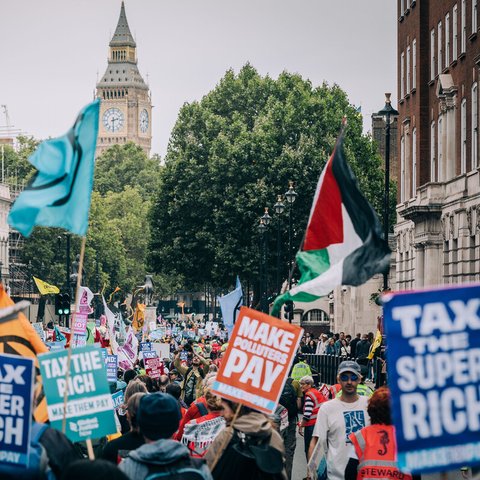
Photo by the Patriotic Millionaires UK

The Bank of England made of stone brick featuring stone pillars and a balcony with a flagpole on the top flying the flag of the UK. There is a red projection on the front of the building with yellow text that says "Tax wealth not work"

Closer to a trillionaire than ending poverty

Oxfam's Davos 2024 report highlights how our economic system funnels billions to billionaires while ordinary workers lose. We are much closer to seeing the world's first trillionaire than ending poverty. A big part of the solution has to be new wealth and windfall taxes, including a European wealth tax.

Billionaires are getting richer — fast

Research published by Oxfam for the 2024 Davos summit revealed that the five richest men in the world have almost doubled their fortunes since 2020. It also uncovers that a billionaire is the chief executive or principal shareholder of seven of the world's ten biggest corporations. This is no coincidence: wealth concentration and corporate monopoly are two sides of the same coin.

Monopoly power fuels inequality

From technology to pharmaceuticals, we are witnessing how modern monopoly men accumulate massive fortunes and influence.

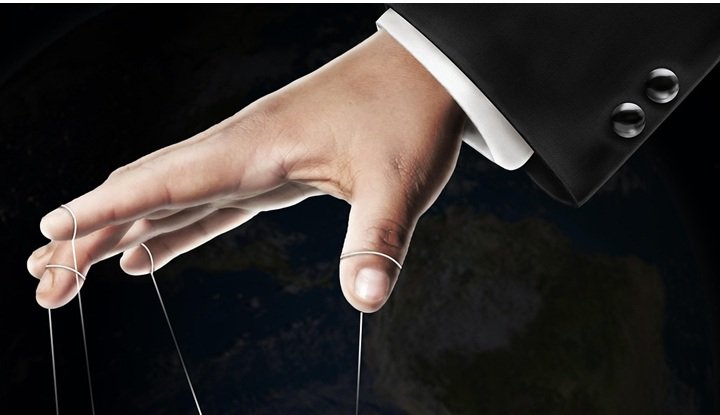
Photo by Sveta Zi/iStock Images

A black and white photo of a hand holding the control bar of a marionette puppet with strings. The puppet is not shown in the picture.

In the European Union, the top five richest men have increased their wealth at a rate of €6 million per hour since 2020. This adds up to an accumulated wealth of more than €400 billion — equivalent to half the education budget for all EU countries.

Companies profit and shareholders win

But behind billionaires are often big corporations, raking in windfall profits. 2023 was the most profitable for huge companies: 22 of the world's biggest headquartered in the EU made €172 billion in net profits in the 12 months to June 2023. This was 66% more than their average profits for 2018-21.

These profits are funnelled to their ultra-rich owners, who can then buy influence in various ways.

Influencing politics and public opinion

Billionaires and their corporations can pay for armies of lobbyists to influence policy-makers to make laws in their favour. They can decide which projects or sectors secure investments or loans and which do not, as the richest 1% own over 40% of global financial assets — including bonds and stocks.

Finally, they can exercise influence over public opinion by controlling important media outlets.

An example is the French billionaire Bernard Arnault. The second richest man in the world, Arnault presides over the luxury-goods empire LVMH, an umbrella for famous French brands such as Christian Dior, Louis Vuitton and Chandon. But his empire does not end with expensive perfumes and champagne: he also owns France's biggest media outlet, Les Échos, as well as Le Parisien. Arnault is just one of many in a system that gives monopolists too much control over the economy and fuels inequality.

How big companies drive inequality

Corporations have become inequality generators. They are making record profits by squeezing workers, dodging taxes, privatising the state and spurring climate breakdown.

Oxfam's analysis shows that fewer than 1% of the world's largest corporations are publicly committed to paying workers a living wage.

Profits over people and the environment

Over the last two years, 800 million workers worldwide have lost €1.4 trillion to inflation — equivalent to 25 days of lost wages for each person. Meanwhile, corporations are distributing 80% of their record profits to the pockets of their already-rich shareholders.

Corporations and their wealthy owners are also driving inequality through a war on taxation. They are incentivising a 'race to the bottom' in their efforts to dodge taxes while depriving the public of better public services. This is why the average corporate-tax rate in the EU has fallen by ten percentage points since 2000 — from 32% to 22% – and why, in the last 30 years, seven out of eight EU countries got rid of wealth taxes.

The privatisation of essential services such as education, water and healthcare — pushed by corporate power — further widens the inequality gap, as it limits access to those who can pay.

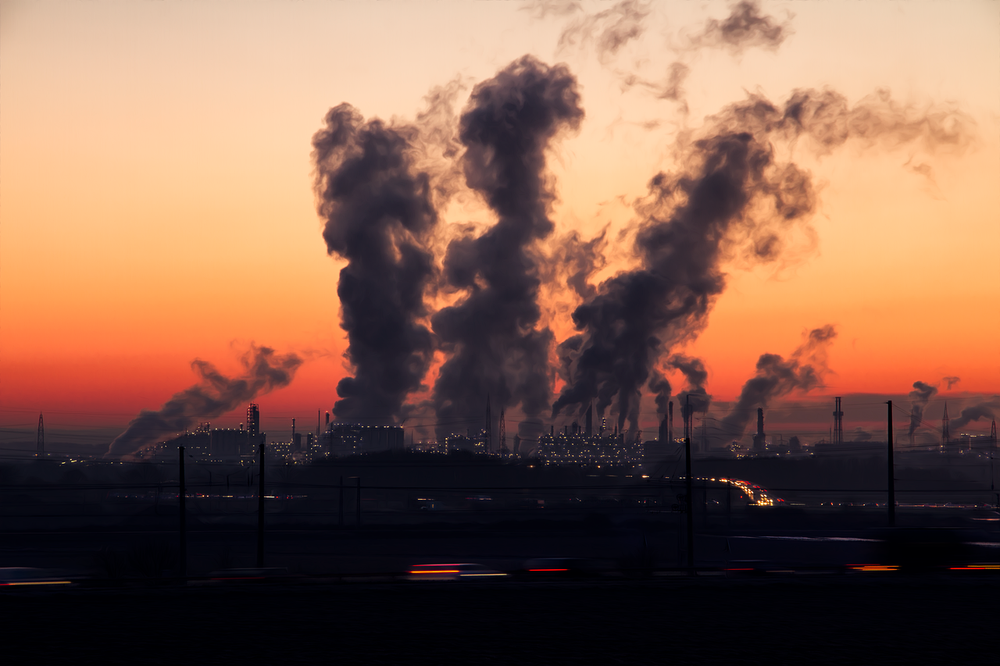
Photo by Lane V. Erickson/Shutterstock

A large factory in silhouette against a clear evening sky with the sunsetting and large plumes of smoke coming out of the factory chimneys.

Polluting smoke rising from a coal-fired power plant.

Finally, corporate power is advancing the climate catastrophe, which is hitting the most vulnerable hardest. Fossil-fuel companies are profiting from their planet-killing business while they block progress on urgent climate action. At the same time, their ultra-rich owners are the most responsible for the climate emergency. Oxfam estimates that a billionaire emits over a million times more than the average person through their luxurious lifestyles and investments. Meanwhile, ordinary people are bearing the brunt of the disastrous effects of heatwaves, floods and landslides caused by human and corporate greed.

Fair taxes is the solution to inequality

The good news is we can stop this. We need governments to regain control. They must guarantee essential public services, regulate corporate power and promote democratically-owned businesses. In this, wealth and corporate taxation represent the cornerstone.

Fair taxes are vital to breaking billionaires' dominance and ensuring our economy does not only serve a handful of ultra-rich individuals but works for ordinary people.

How much could wealth taxes raise?

For example, a European wealth tax could raise nearly €300 billion a year — enough to cover 40% of the EU's Recovery and Resilience fund. This small tax, at a rate between 2% and 5% on EU multi-millionaires and billionaires, would not only boost governments' coffers to fight inequality but would also make rich polluters pay for their role in the climate crisis.

This is why Oxfam is supporting — together with economists, multi-millionaires and politicians — a European Citizens' Initiative for a European wealth tax. Every hour governments fail to take action is literally costing millions of euros; with the petition, Europeans are calling on the EU to move to end this and tax the rich.

The same goes for windfall and excess profits of corporations. New analysis by Action Aid, in collaboration with Oxfam, shows that a 90% tax on windfall profits, applied to the 36 largest companies in fossil fuels and banking around the world, could raise close to $382 billion. This is almost 20 times what was spent globally on climate adaptation in 2021.

A global effort

The scale is unprecedented and it is a global problem. To stop the world's wealthiest and biggest corporations avoiding paying their fair share of tax we need a global effort, such as the United Nations convention on tax advocated by African countries, resisted by EU member states.

We are entering a decade of division. Taxes on wealth and corporations, along with more state, public power and sustainable business, are the only way to create an economy free from billionaire supremacy. It is time for an economy that works for ordinary people and the planet.

Sources