Kampus Production / Pexels


An older man wearing a navy checked shirt and a pale cardigan is holding a basket of produce in a shop whilst looking at the back of a box

Corporate profits are driving the cost‑of‑living crisis

Corporations that dominate food and fuel markets have been using the war in Ukraine and the pandemic as a smokescreen to bump up their prices much more than their costs. Oxfam explains how increased corporate profits have driven at least half of inflation.

What is 'greedflation' and why does it matter?

Open an economics textbook and it will tell you something that intuitively makes sense: when there’s a shortage of something (supply falls) or everyone wants something more (demand rises), prices go up.

In recent years, we have indeed had inflationary pressure from both supply and demand. First there was pandemic-related supply chain disruption (think shortages of microchips or baby formula), then the supply shocks caused by the war in Ukraine (think food blockades or sanctions on Russian oil and gas). Meanwhile, on the demand side, higher-income households used pandemic savings to go on a spending spree when economies re-opened, boosting demand and prices.

However, there’s another huge factor driving inflation that you won’t find in the basic, textbook economics model – one that has driven at least half of price increases in developed nations: excess corporate profit, or what some have dubbed ’greedflation’.

When profit maximisation meets opportunity

Studies in the following countries found that excess corporate profits drove inflation:

The idea is simple – as global prices rose due to the supply and demand drivers, corporations increased their prices.

Corporations didn’t just increase prices to cover higher costs

They used the war and pandemic as a smokescreen to bump up their profits and margins. You may remember when oil prices and fuel pump prices rocketed. Yet, a few months later as wholesale oil prices began to decline, they didn’t drop much.

Economist Lyndsay Owens, who has been tracking these earnings, put it best though, saying recent price rises could be viewed as a moment when “profit maximisation and opportunity collides”.

Market power hiking prices

Around the world, corporate profits in some sectors are soaring. In the US, profit margins are at their highest in 70 years. In the UK, the margins of the 350 biggest listed corporations were 74% higher than before the pandemic and in Spain 2022 profit margins were 60% higher than in 2019.

Conventional economic models will say that, because free markets are competitive, companies will be forced to lower their prices – or their competitors will, and take their business. However, some sectors have become so concentrated that there isn’t much competition. Anyone who’s played the board game Monopoly knows how that ends.

Food and energy are the big winners

Nowhere is market concentration more apparent than in the food and energy sectors. In the US, for example, four corporations control 55% to 85% of meat sales. Four food traders control 70% of global grain. Six oil giants dominate global energy production.

These sectors are driving the lion’s share of inflation – as the graph below shows, the increasing cost of food is a major driver of inflation, as is energy – both directly but also when including transport. The inflation from food alone is more than overall inflation from 2016-2020.

Inflation drivers

The following chart shows that food and energy prices continue to drive the global inflation surge. Figures are shown in percent and media inflation rate.

IMF CPI database and IMF staff calculations
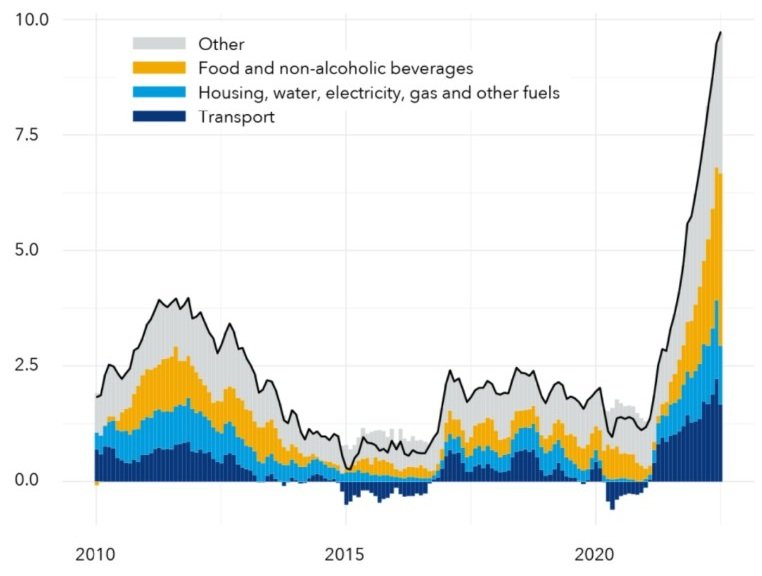
A graph charting inflation drivers between 2010 to 2023 showing that food and energy prices continue to drive the global inflation surge.

The median total inflation in select categories across 88 countries, including 28 advanced economies and 60 emerging and developing countries.

Given the evidence that corporate profits are fuelling inflation and that food and energy prices are the most significant part of inflation, we teamed up with our data analytics friends at Exerica. We had already worked together – using their cutting-edge AI technology to track the investment emissions of the world’s richest people for our Carbon Billionaires report – and together we investigated the corporate profits in these sectors.

We found that the corporations in these sectors made eye-watering windfall profits in 2022. Just 95 corporations made $306 billion in windfall profits.

Overall, profits of food and energy corporations increased by 256%, of which 84% was paid to rich shareholders in the form of dividends and buybacks. Most striking of all, though, was the profit margins. Some argue that windfall profits are just the product of companies passing on increased costs to consumers. However increased margins suggests that they are taking advantage of the crises to boost their profits. Our research found that 76% of the companies increased their net profit margins.

The sectors making windfall profits

Food companies

Of the 46 food companies in the sample, which made a combined $70 billion in windfall profits, 39 (85%) had increased their margin. They also paid $82 billion to rich shareholders in 2022.

Some sub-sectors have had particularly notable increases in profits: synthetic fertiliser companies increased their profits 10 times on average, meat companies by five times, while farm equipment and agriculture commodity traders almost two times.

Unsurprisingly, some of these industries have been under the spotlight: the meat industry in the US, for example, following revelations of massively increased profits, has been targeted by the Biden administration plans to boost competition in the industry. Fertiliser companies are reaping the benefit of increasing gas prices making life impossibly expensive for farmers. Friends in Kenya have told me about the terrible decision families are now having to make between feeding their crops with fertiliser and putting food on the table.

Energy companies

As oil and gas prices shot up in 2022, energy companies cashed in. Combined, these 49 corporations made $237 billion in windfall profits in 2022 and paid $157 billion to rich shareholders – 35 of these 49 companies (71%) increased their profit margins.

Governments across Europe and Latin America have introduced windfall taxes in response to these excess profits but despite record profits large companies have yet to pay anything. One oil company is even suing the EU over these taxes.

What impact does large profits have on inflation?

At the national level, government statistics can shed a light on ‘greedflation’. An Economic Policy Institute study in the US calculated that 53.9% of price growth could be attributed to increased profit margins, while labour costs were less than 8%. It makes clear that it wasn’t just that corporations were benefiting from inflation, but their excess profits are fuelling it.

We tried to develop a methodology to calculate precisely how much large food and energy companies are contributing to inflation – but were unable to because a lack of available data.

What we can show, however, is an example of how increased profit margins are affecting consumer prices. Take the grocery sector for example – between 2018 to 2021 for every $100 spent in a grocery store (in our sample), $8 was net profit while in 2022 that was more like $12. Food inflation was about 10%:

A $100 grocery bill in 2021 would have cost $110 in 2022. If the grocery corporations had maintained their previous margins, that 2022 bill for those groceries would have been more like $106.”

And this is just the consumer-facing companies – if all the corporations, from the seed and fertilizer corporations to the traders and manufacturers weren’t adding to their profit margins, then there’s good reason to think food inflation would be even less.

This cost-of-living crisis is driving poverty and exacerbating hunger – the world’s poorest pay a far greater share of their income on food and energy and so any price increases hit them hardest.

Gas cylinders used to cost Rs 450, but now they cost slightly more than a thousand rupees [$12]. Now we have to choose between feeding our children or educating them.”

Yusuf, taxi driver, India

Two ways to address corporate profiteering

Introduce a windfall profits tax across all sectors

Re-distribute the ill-gotten gains into social good to help people around the world affected by the cost-of-living crisis.

A 90% tax on the windfall profits of the 1,000 largest companies in the world could generate over $1 trillion. It would also help reduce inequality. Most company profits go directly to shareholders who overwhelmingly sit in the richest 1%. For example the richest 1% own 54% of the shares held by US households.

Limit companies’ market power

Proposals such as introducing and enforcing competition laws as well as re-framing the way companies are run so employees have a stronger voice. Oxfam’s Power, Profits and the Pandemic published in mid-2020 warned of the risks of unbridled corporate power and sets out how to tackle it.

Inflation isn’t just happening because of our global crises. It is happening because we are failing to limit corporate power.

Our governments have a choice:

  1. curb this power and tax windfall gains to ease the cost-of-living pain, or
  2. continue to allow price gouging to run rampant, bringing untold misery to hundreds of millions of people across the world.

Post script note on the methodology

How did we calculate windfall profits?

We drew up a sample of the largest corporations in the two sectors based on ETC Group Food Barons report and the S&P Global Energy ranking. We couldn’t get data on all the corporations, either because they are private and don’t make their financial information public, or don’t report quarterly (we conducted the research in October 2022 so the latest quarterly data we had was either for the end of June or September).

In total we ended up with a sample of 181 companies from 29 countries. Exerica then calculated the trailing twelve-month (TTM) figures – the sum of the preceding 12 months and converted it all to USD so everything was comparable. We ended up with revenue, net profit, dividend and buyback data going back to 2018.

We needed to calculate which companies had made a windfall profit. To do this we drew on the methodology the European Union propose. We compared the 2022 profits + 10% (the EU propose 20% but we think that’s too high*) to the average profits (losses are treated as 0) between 2018-2021.

According to this definition, of the 181 food and energy corporations we started with, 95 made a windfall profit.