Duncan Green

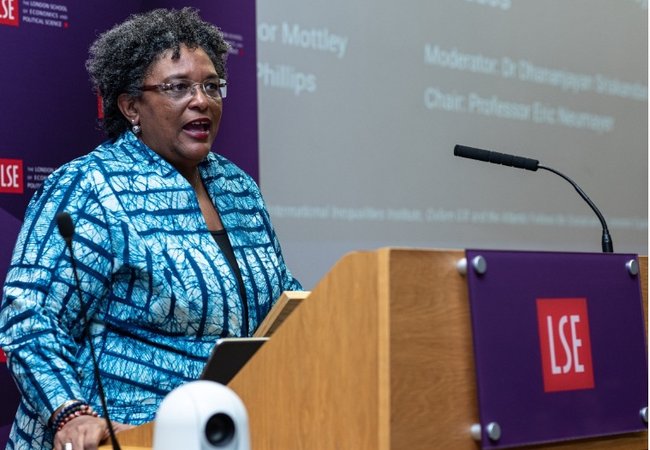
Mia Mottley standing at a wooden podium with a large screen behind her giving a speech to the London School of Economics.

Mia Mottley on justice, climate action and global leadership

Recognize that each of us has a role in legitimizing the conversation to repair the soul, to repair the family, to repair the community and nation...”

Mia Mottley

Hosted by the London School of Economics' (LSE) International Inequalities Institute, Barbados Prime Minister Mia Mottley delivered a wide‑ranging speech exploring the legacies of slavery, the realities of global inequality and the urgent need for climate action.

Her message combined moral clarity with a vision for a fairer international system that recognises we have a shared humanity and responsibility. This blog captures key moments from her powerful address.

A powerful vision for global justice and leadership

It was jaw-dropping for both the performance, interweaving segments from Mottley with poems from Barbados’ poet laureate, Esther Phillips, and the sheer range of Mottley’s narrative, taking in slavery, reparations, and the need to heal and come together to deal with common challenges like poverty and the climate crisis. And it was all delivered with Obama-esque levels of oratory – I felt like we were seeing a future UN Secretary General in action, should she want such a thankless job.

It also felt like exactly what Oxfam’s future role should include – catalysing a powerful conversation on colonialism, justice, inequality and climate without hogging the limelight. Bravo. However, it did also highlight a gap that I’m becoming increasingly aware of – class. A subject for another blog.

I used Descript to generate a transcript, then edited it down to blog length below. It won’t do justice to the magnetic power of the performance, but it may give you a flavour of the powerful words from Mia Mottley.

Understanding the legacy of slavery and the call for truth

We didn’t control the printing presses. We didn’t control the narrative. We didn’t control the governments. We became independent. And we started to tell our story. Here, there, everywhere. But always in muted tones. And always as if it didn’t matter.

In case I thought it was us, then I remembered in June 2022, when the Commonwealth Heads of Government meeting took place in Rwanda. And your king, King Charles, delivered some words that we would do well to recall:

If we are to forge a common future that benefits all of our citizens, we too must find new ways to acknowledge our past.”

King Charles III

Quite simply. This is a conversation whose time has come.

Why historical honest matters

These conversations are painful, they may offend some, but they ought not to, because we are mature. And we must have the capacity to have mature conversations because we are not children. And that ability to have conversations, even when we are directly complicit, must never escape us.

The silence is anchored not just in a conspiracy; it is a silence that is born out of shame. For many of our people, the shame is too great a burden to carry. The notion that persons could be treated as subhuman. The notion that you could have not just lashes on your back, but your nose would be slit and your face burnt. That that was a legitimate penalty in the 1661 Slave Code, passed by the Parliament of Barbados. The Parliament that I now have the honour and privilege to lead.

We do not have the luxury of changing the course of history, but we do have the solemn obligation to right the wrongs and to allow people to be able to breathe.

Confronting poverty in all its forms

We believe fundamentally that the problems are deep and so systemic that it is not only economic poverty, but poverty of mind and poverty of spirit – the other aspects of poverty that downpress and suppress people – that must equally be fought.

Building collective strength and moral leadership

What is required is the unleashing and the unlocking of that communal effort.

We must work with each other, not just in Barbados, but across the world, to create a movement that sees people, that feels people, that hears people;.

That understands when all others and all other things are gone, the family ought to be that nurturing unit that takes our children and helps shape them.

That roots them in the values of determining what is right and what is wrong.

That speaks to them of the fact that there is nothing to be gained by retribution, that what is required is never to forget, but always to aspire to moral strategic leadership; not because it sounds good to say so, but because it is necessary to reduce conflict and to work together on the things that matter in this, our world.

George Floyd and the need for healing and justice

Four hundred years of hate in a white man’s knee on his neck.

What would cause someone to believe that you can literally constrain the breathing of another human being for 9 minutes and 29 seconds? Because, not until we understand what would drive that can we begin the process of completing the healing, the process of redemption. And redemption of those who are oppressed is perhaps one of the most important missions that we must undertake.

We must never forget the past, but we must seek to heal and to allow for redemption.

Recognizing our shared humanity

What stops us from recognizing humanity in each other? That’s why in 2018 and consistently since then, on behalf of my nation, Barbados, we call for global moral strategic leadership. Because what the world needs now more than ever is people who understand that principle must guide actions. And that principles only mean something when it is inconvenient to stand by them.

None of us are made perfect; there will be times when we will fall short. But it’s that ability to acknowledge it and to seek redemption that will define us as a civilization, our ability to move on to strength rather than languishing in the shadows of a disgraceful history.

Climate justice and fair finance

As we speak with COP28 behind us, we know more than ever the need to ensure that those who were not the ones who spawned the current climate crisis ought not to be forced to accumulate debt or to deny their citizens the right to development.

Morally, it is the right thing to do. Strategically, it is the right thing to do.

If we accept that small countries can cause and do things that can undermine the public health of their citizens – and, by extension, with global air travel, can undermine the health of the entire world – then we can’t leave ourselves open to that possibility by denying them the opportunity to be able to provide the best class of public health that they can to their citizens.

Reforming the international system for a fairer world

We cannot talk about repairing the community and repairing the nation state without equally talking about repairing the governance mechanisms at the international level. The United Nations cannot continue to have at the core of its Security Council five nations who more reflect an imperial order than the diversity of the 193 nations of the world today.

Not until we understand that there is only one human race on this planet, that we have an obligation to define what is the role of each and every one of us in the greatest battle that humanity must face.

Reimagining global governance for today’s world

Each of us will be required to carry weight, even those who are victims. And that’s why the issue of redemption and apology and all of these things need to be put to one side. Because the world, more than ever, needs us to act with singular purpose. The world, more than ever, does not have the luxury of going on pause with the climate crisis because of wars in Europe, the Middle East, or Africa.

But if we are busy not being able to talk with one another, and not to work with one another, then we will find that even that will become a bridge too far for us. In the words of Haile Selassie, popularized by Bob Marley, not until there are no first class and second class citizens of the world, can we truly put forward the best effort to save humanity.

This is not about saving the North Atlantic countries, or saving Africa, or saving Asia. This is about saving the planet Earth.

I ask us as we leave this room today to recognize that each of us has a role in legitimizing the conversation to repair the soul, to repair the family, to repair the community and nation, and to repair the international order that has done so much to leave us on our knees.

Watch Mia Mottley's speech in full

About the author

Duncan Green

Founder of Oxfam's From Poverty to Power blog and former strategic adviser for Oxfam GB. He is now Co-Director (with Tom Kirk) of the LSE’s Activism, Change and Influence programme and website and a Professor in Practice in the LSE’s International Development department.

He is author of the books ‘From Poverty to Power‘ and ‘How Change Happens’.