Asian Peoples’ Movement on Debt and Development
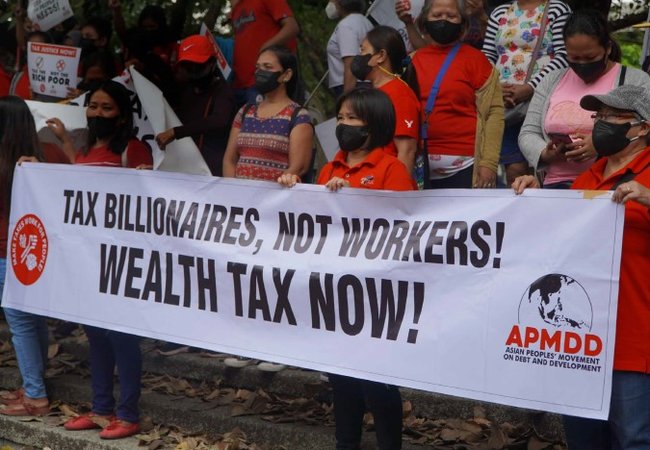
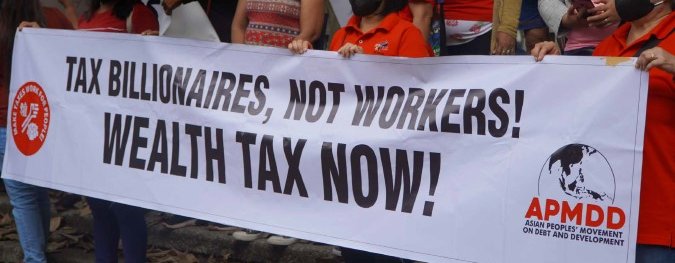
A group of women at a demonstration holding a large banner that reads "Tax billionaires, not workers! Wealth tax now!" The foreground sponsor logo is for the Asian Peoples' Movement on Debt and Development.

Taxing the super-rich has collapsed and it needs to change

When even millionaires are pleading to be taxed so governments can tackle our colliding global crises, we can see there’s something rotten in the state of economic policy.

Oxfam's 2023 Davos report explores why fair taxation on extreme wealth is vital to ending poverty.

Rising inequality in a global cost-of-living crisis

Walter is the father of my son’s best friend at school. He works nights as a security guard at a bank in the City of London. He has three kids. They are really struggling, as the prices of everything – gas, electricity, food – have all increased dramatically. Where £20 would have bought enough electricity for a week, it now lasts just a couple of days.

But Walter, whose family come from Sierra Leone, and who returned there recently for his mum’s funeral, counts himself lucky: “I think of all those back home with literally nothing. No job, no money coming in, and prices just going up and up. It is terrible.”

Families struggling to survive

Walter’s story is typical of hundreds of millions of families worldwide. Hundreds of millions of small domestic tragedies playing themselves out, as brutal, impossible choices must be made. Between healthcare for your sick child and food for the rest of the family. Between heating your home and having a hot meal.

When it comes to taxing the super-rich, so many governments have not even got the basics in place. No inheritance tax. No property tax. No taxes on gains from capital. Let alone taxes on wealth.

Nearly one in eight people are going to bed hungry.”

Max Lawson, contributing author on Survival of the Richest: How we must tax the super-rich now to fight inequality
Multiple crises driving millions into poverty

In all the years I have worked for Oxfam, I have never seen such a combination of terrible crises impact so hard on ordinary people all over the world. First Covid-19, and now the cost-of-living crisis – coming on top of years of rising inequality and climate breakdown – have driven up the numbers of people living in poverty for the first time in 25 years.

Global inequality, that is between the rich world and the rest of the world, has seen the largest rise since World War 2.

Max Lawson

Like so many people across the globe, Walter, a security guard in London, faces a surge in the cost of living.

The richest 1% are obtaining wealth at record levels

It is against this dramatic backdrop of crisis and suffering that we launch Oxfam's annual report on inequality, as billionaires and world leaders once again make the trip to the mountain top in Switzerland for the Davos World Economic Forum.

The insane riches at the top of our world are appalling at any moment in history, but right now, it feels even more stark. Especially when you see that the rate of accumulation of wealth for the super-rich has actually accelerated during this crisis period.

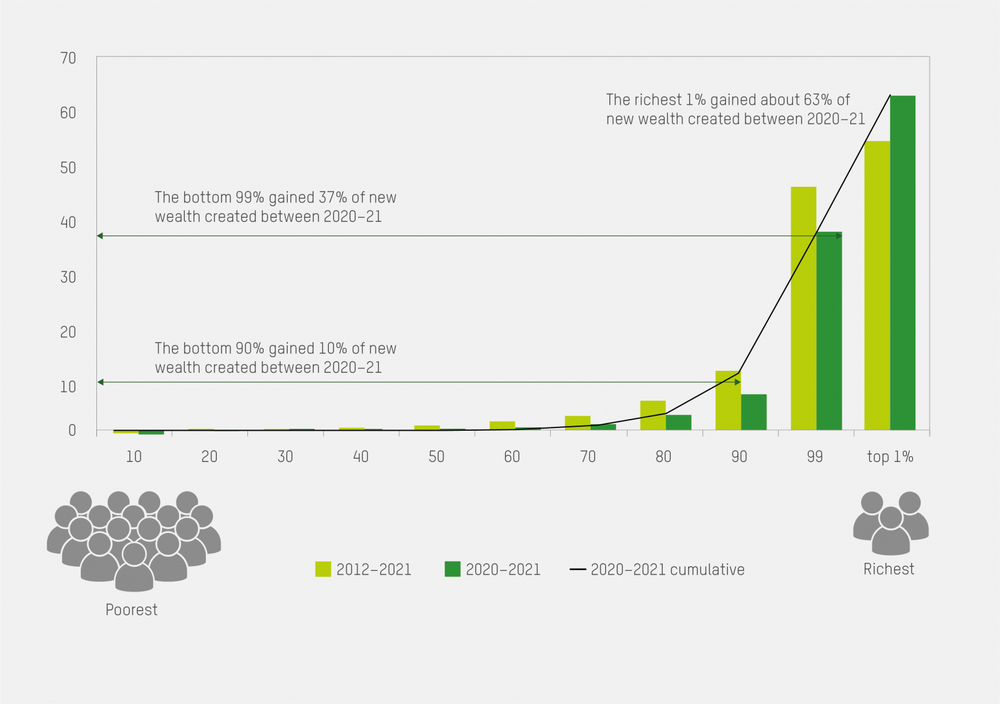
Since 2020, the top 1% (those with wealth over $1 million) have captured almost two thirds of all new wealth.”

The acceleration of extreme wealth

Over the last decade, the richest 1% captured about half of all new wealth created in the world. This is already entirely inexcusable. But since the beginning of the decade, this pace of accumulation has dramatically increased.

Since 2020, the top 1% (and to be in the top 1% you need to have wealth of just over $1 million dollars), have captured almost two thirds of all new wealth. So since the beginning of the decade, the richest 1% of people have captured almost twice as much wealth as the whole of the rest of humanity put together.

A graph showing the share of new wealth gained where the bottom 90% gained 10% of new wealth created between 2020-21 and the richest 1% gained 63% of new wealth created in the same period

"Share of new wealth", graph taken from "Survival of the Richest: How we must tax the super-rich now to fight inequality".

The first Davos inequality report was published in 2014. In that decade, the wealth of the world’s billionaires, and the number of billionaires has basically doubled. How long can this go on?

The rest of the world is falling behind

Economic inequality of course intersects with inequalities of gender, race and colonialism; the majority of the richest people and the majority of the world’s wealth is owned by white men in the Global North. Of the world’s thousand richest people, only 125 are women and only five are black.

Our report also drills down into the winners from the cost-of-living crisis. We point to research from Australia, the UK, Spain and the USA which shows that at least 50% of the increase in inflation is due to corporates cashing in on price rises and profiteering from the crisis.

Taxing the super-rich must be part of the solution
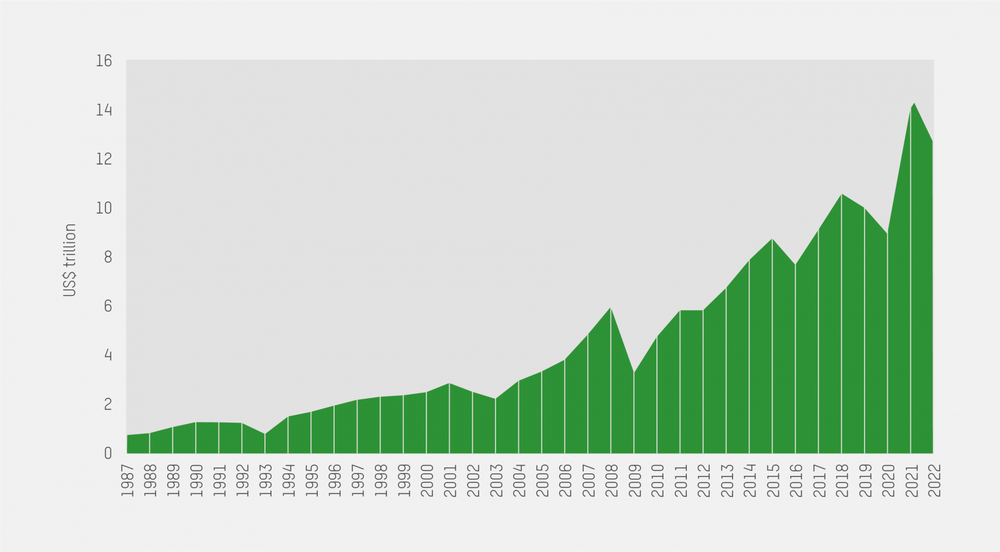
A graph showing the increase in billionaire wealth from 1987-2022 in US $trillion (real terms). There was a sharp drop in 2008 which then increases rapidly from 2009 onwards.

"Increase in billionaire wealth 1987-2022 in US $trillion (real terms)", graph taken from "Survival of the Richest: How we must tax the super-rich now to fight inequality".
The report shows that 95 food and energy corporations have more than doubled their profits in 2022. They made $306 billion in windfall profits and paid out $257 billion (84%) of that to rich shareholders. The Walton family of billionaires, which owns half of Walmart, received $8.5 billion over the last year.

The impact of inflation is being felt by workers worldwide; we found that 1.7 billion workers are living in countries where prices are outpacing wages.

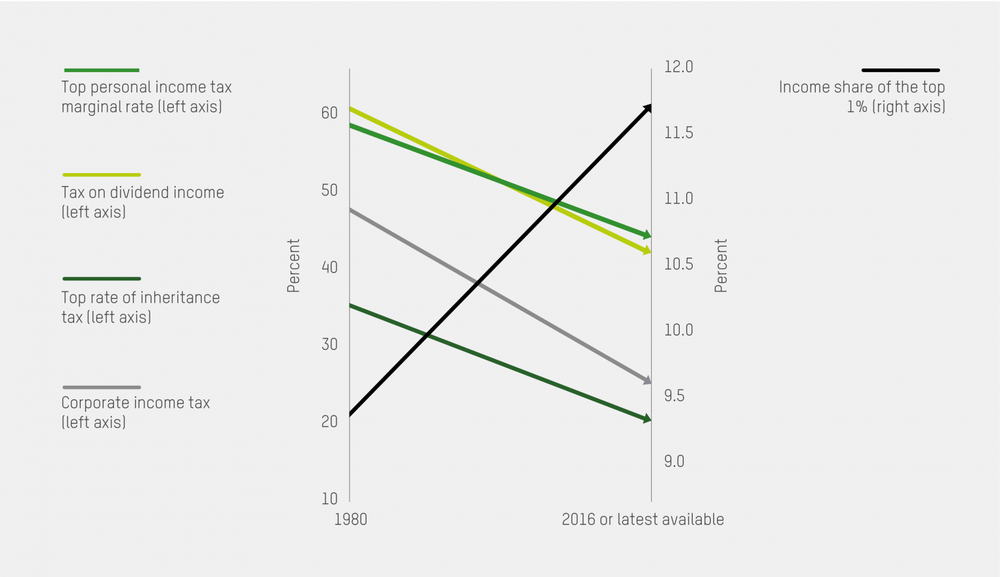
In 2023, the main focus of our report is on taxing the super-rich. Our report details how the last 40 years have seen a collapse in taxation of the richest people. This has been accompanied by a big jump in the share of income going to the top 1%.

A graphic depicting the falling rates of tax coinciding with the rising share of income on the top 1% between 1980 and 2016.

In rich countries, falling rates of tax on the rich have coincided with a rising share of income going to the top 1%

Half of the world’s billionaires, for example, live in countries where there is no inheritance tax on bequests to children, meaning that $5 trillion dollars, a figure greater than the entire GDP of Africa, could be handed on without a penny of tax being paid, creating a whole new global aristocracy.

Why are we not taxing the super-rich?

When it comes to taxing the super-rich, so many governments have not even got the basics in place. No inheritance tax. No property tax. No taxes on gains from capital. Let alone taxes on wealth.

And as white men are the most likely to be rich, they are the biggest beneficiaries of this failure to tax the rich.

We think the top rate of tax on the super-rich 1% should be a lot higher; for example 60%, and higher still for the multi-millionaires and the billionaires.

Higher tax rates used to be standard

For large parts of the 20th century, it was normal to tax the incomes of the richest at 60% or above.

In the US, top federal income taxes stood at 91% from 1951 to 1963, and 70% as recently as the 1980s. The country’s top inheritance tax rate was 77% until 1975. These taxes on the wealthiest went hand in hand with decades of successful economic development.

Whilst calls for taxing the rich are not new, the current global context – huge suffering, bankrupt governments, spending cuts, hunger – is. The anger at austerity and frustration at the cost-of-living crisis is something I haven’t seen since the financial crisis in 2008. The wholesale rejection of our short-lived and little loved UK prime minister Liz Truss when she tried to cut taxes for the richest was, I hope, a real watershed moment.

How to raise $2 trillion

In Latin America, a group of nations, led by Colombia and Chile, have concrete plans to increase taxation on the richest. Other nations across the world are doing the same.

Protests are happening around the world and at Davos itself to demand an end to inequality. Millionaires joined the protests in Switzerland, demanding to be taxed in what must be the ultimate man bites dog moment.

The volumes of money that could be raised are truly spectacular and reflect the huge explosion in private wealth that has mirrored the increase in public debt since the financial crisis.

Massive interventions by governments and central banks have in turn driven up asset prices worldwide and with this the fortunes of those at the top.

This increase in wealth is not because rich people have worked harder, or become more clever or entrepreneurial, it is instead a structural by-product of the necessary actions governments had to take, making the case for clawing some of this money back even more compelling.”

Max Lawson, contributing author on Survival of the Richest: How we must tax the super-rich now to fight inequality

Raise taxes and reduce poverty

Together with Patriotic Millionaires and the Fight Inequality Alliance, we have calculated that a wealth tax – of 2% on the world’s millionaires, 3% on those with wealth above $50m, and 5% on the world’s billionaires – could raise $1.7 trillion dollars annually. This would be enough for transformative change, including lifting 2 billion people out of poverty and funding a global plan to end hunger. It could hugely contribute to the demands of developing nations to fund the loss and damage caused by runaway climate breakdown.

Every billionaire is a policy failure. Every billionaire is a sign of an economy that is failing the majority.

It is time to build a more equal world, where both poverty and extreme wealth are consigned to the history books once and for all.

About the author

Max Lawson is Head of Inequality Policy at Oxfam International and a contributing author on Survival of the Richest: How we must tax the super-rich now to fight inequality