Photo: Alexi Rosenfeld/Shutterstock

Who wants to be a trillionaire? Why extreme wealth matters for all of us

What does it mean when five men could become trillionaires? Oxfam's research, published to coincide with Davos 2025, reveals the shocking pace of wealth inequality — and what we can do to stop it.

A game show we never signed up for

Remember the TV show Who Wants to Be a Millionaire? It made us believe that with hard work, a little luck, and maybe a phone call to a friend, anyone could win big. But today, the stakes have changed. The question isn't about becoming a millionaire — it's about trillionaires.

Oxfam's research published in January 2025 predicted that within 10 years, five men could each hold wealth worth one trillion dollars. That's a number so big it's hard to imagine. But behind that headline is a story about inequality, power, and the choices we all face.

Getting to five trillionaires within a decade
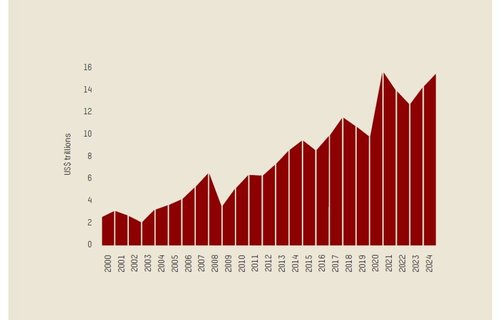
A graph showing the increase in billionaire wealth between 2000 to 2024 in US dollars starting at just over 2 trillion and increasing to over 14 trillion with some dips in 2002, 2008, 2015, 2019 and 2022.

We've been keeping a close eye on how billionaire wealth has evolved since 2014 when Oxfam calculated that the 85 richest people owned as much wealth as half the world.

2024 saw the second highest level, and the second fastest growth, in billionaire wealth. In 2023 we forecasted that there would be a trillionaire within a decade. The massive acceleration of billionaire wealth means there could now be five.

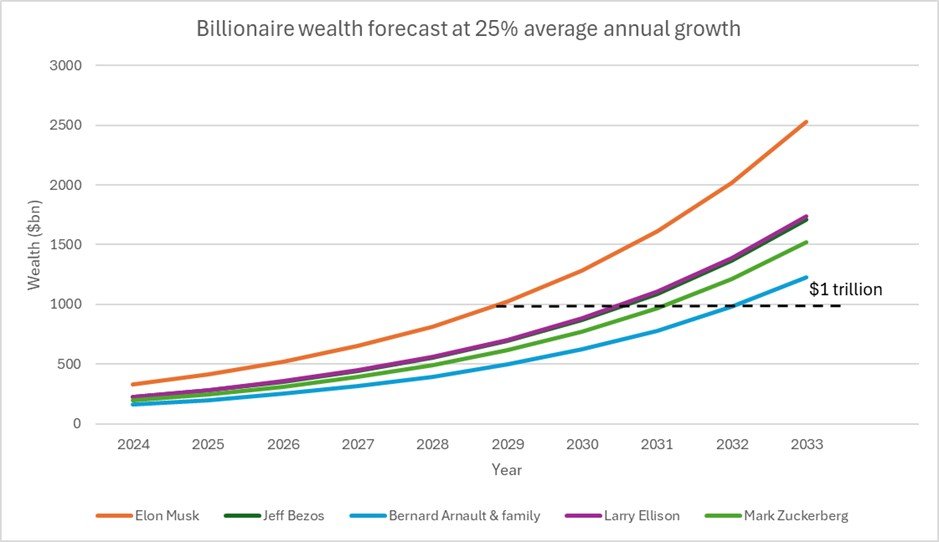
To calculate this stat, first, we worked out the average annual growth rate of their wealth (adjusted to 2024 prices) over the past five years which was 25%. We then applied a natural logarithm function which is used to calculate the time needed to reach a certain level of growth – in this case $1 trillion – as shown in the graph below.

How did we calculate trillionaire wealth?

It's not like there's a universally agreed methodology to forecast trillionaires and there are many different ways to make this forecast and deal with outliers.

It's fair, for example, to ask why we took the average of the five growth rates, rather than use their individual growth rate or why we chose 2019 as a start date.

"Takers not makers" methodology note

A graph forecasting billionaire wealth at 25% average annual growth from 2024 to 2033. Five different coloured lines represent 5 billionaires - Elon Musk, Jeff Bezos, Bernard Arnault and family, Larry Ellison and Mark Zuckerberg.

Different methods deliver the same results

We looked at various options which resulted in similar or more extreme results.

We calculated the statistic using an "annualised growth rate" (which takes into account the compounding effect) which resulted in the same five trillionaires within a decade forecast.

If we use the billionaires' individual growth rate, rather than the 25% average, of the 17 billionaires who have wealth over $100bn? Drum roll please… five would be trillionaires within 10 years.

What happens if we change the start date? We looked at the growth since 2022 rather than 2019 and again Excel spat out the same five trillionaires statistic.

In fact, individual growth rates can deliver even more startling results. We took the entire Forbes billionaire list and applied the individual growth rate. Using this formula there would be 28 trillionaires within a decade! However, this is extremely unlikely given that many of those people got extraordinarily rich overnight because of a one-off event.

Having looked at the alternative options and based on our experience of studying billionaire wealth over the last 10 years, we felt that the most likely group to maintain their rate of growth was the very top group of billionaires and that the best way to control for outliers was to use an average of the top five growth rates.

Could there be a trillionaire sooner?

It's worth noting that we did these figures at the end of November 2024. Since the US elections around that time, the wealth of the world's very richest men has taken off like a rocket.

At this rate, I wouldn't completely rule out there being a trillionaire by the time we do the stats for our next inequality paper. That would make quite the headline for Davos 2026!

The hidden cost of extreme wealth

Why does all this matter to ordinary people? Here's the reality:

  • Inherited privilege plays a huge role. Over a third of billionaire wealth is passed down from parents.
  • Global inequality fuels the system. Nearly $1 trillion is extracted from the Global South every year through financial mechanisms that benefit the richest.
  • Monopolies and political connections matter. Almost a quarter of billionaire wealth comes from cronyism or monopoly power.
  • Tax avoidance keeps fortunes growing. Around $200 billion is lost annually because corporations dodge taxes – money that could fund schools, hospitals, and climate action.

What can we do to tackle extreme wealth?

At Oxfam, we believe in a world where everyone has a fair chance — not just a lucky few. Here's how we can start:

  • Tax justice: Governments must ensure the richest pay their fair share.
  • Invest in people: Redirect resources into healthcare, education, and climate solutions.
  • Challenge monopolies: Break up systems that concentrate wealth and power.
  • Stand together: Support campaigns that demand accountability and fairness.

Change happens when people speak up. Every voice matters — including yours”

Alex Maitland, Inequality Policy Adviser, Oxfam International

A future worth fighting for

The idea of trillionaires might sound like a game show gimmick, but it's real — and it affects all of us. We can't afford to sit back and watch inequality spiral out of control. Together, we can rewrite the rules so that wealth serves humanity, not the other way around.

Sources

You can see the full workings for all the key stats in our Davos report in our detailed methodology note.