Anika visiting the house of Hanna in Chernihiv, Ukraine, where new windows were installed to replace those damaged by shelling. Photo: Olha Petrova/Oxfam
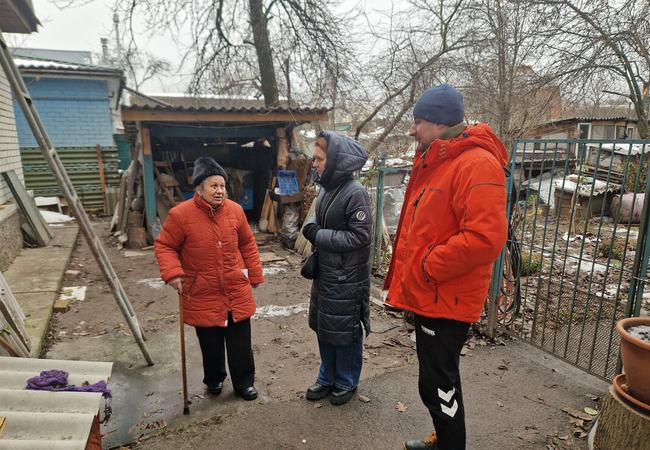
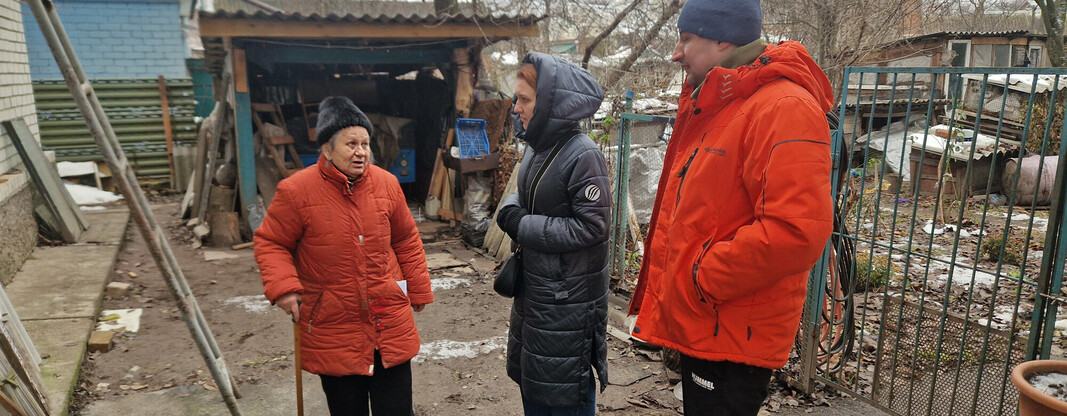
Hanna is standing with a walking stick outside her home that has been damaged by shelling. It is winter and they are all wearing big coats and hats. Hanna is talking to Anika who is visiting to see the newly installed windows.

How a few powerful nations hijacked global peace

Millions of people are living through crises that international leaders have failed to prevent or resolve. Oxfam’s Vetoing Humanity report shows how the United Nations Security Council – created to safeguard global peace – is being held back by the veto power of a few influential countries.

The result is decades of unresolved conflict, rising humanitarian needs, and decisions shaped more by political interests than by the safety and rights of people living through these emergencies.

Ahead of the landmark Summit of the Future, Oxfam demands four changes to reform a UN system that is simply no longer up to the challenge of maintaining international peace and security.

A global peace system failing the people it should protect

The promise of the United Nations Security Council (UNSC) to maintain international peace and security is broken. Conflict around the globe is rife. Dozens of conflicts have raged, some for decades, with no sign of stopping, leaving an unprecedented trail of human suffering.

The 23 protracted crises examined in this report have been included in the UN’s Global Humanitarian Needs Overview for at least five of the last ten years.

Rising humanitarian needs

Over the last decade alone, conflict has killed 1.1 million people in those 23 crises. Millions have been forced out of their homes, and conflict has been the primary driver of hunger – pushing 135 million conflict-affected people into severe hunger.

During the same period, the number of people in need of humanitarian assistance has risen nearly four times, driving funding needs to nearly triple – from US$20.3bn to a staggering US$56.1bn – to address this escalation in human suffering.

How veto power and political interests block peace

This is not a coincidence. A handful of powerful nations who represent only 25% of the world population, but hold its nuclear button, have too often manipulated the global peace and security system to meet their geopolitical and economic interests.

Between 2014 and 2024, one or more of the five permanent UNSC member states (the P5) vetoed 30 UNSC resolutions on protracted crises, including resolutions on the Occupied Palestinian Territory (OPT) and Israel, Ukraine, Syria and Yemen.

Russia and the USA cast 75% of the 88 UNSC vetoes since 1989, with the rest by China – neither France nor the UK have used their veto power over that period.

Many of the vetoes obstructed resolutions that were similar to those that overwhelmingly passed in the UN General Assembly (UNGA).

Moreover, the P5 have deliberately cherry-picked which conflicts to address in the Council. Over the last decade, over 95% of the resolutions that the UNSC passed relate to just half of the protracted crises, leaving the other half mostly neglected.

The human impact of UNSC paralysis

The P5 are not homogenous: some of these influential countries have expressed openness to reform where others have, and continue, to use the veto in violation of the Charter’s own provisions.

UN Dag Hammarskjöld Library. (n.d.). UN Security Council Meetings and Outcomes Tables: Veto List.
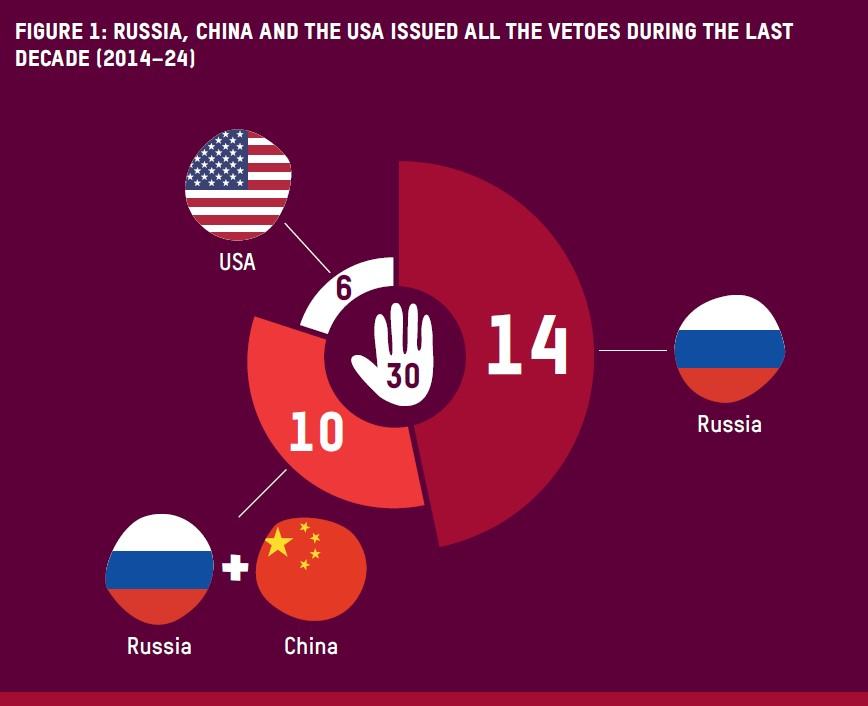
A pie chart graphic showing the countries who issued vetos between 2014-2024. Out of 30 conflicts discussed Russia, China and USA issued all vetos.

The gridlock within the UNSC has left the 23 crises discussed in this paper largely unresolved, namely:

  • Afghanistan
  • Burkina Faso
  • Burundi
  • Cameroon
  • Central African Republic (CAR)
  • Chad
  • Democratic Republic of Congo (DRC)
  • Ethiopia
  • Haiti
  • Iraq
  • Libya
  • Mali
  • Myanmar
  • Niger
  • Nigeria
  • OPT
  • Somalia
  • South Sudan
  • Sudan
  • Syria
  • Ukraine
  • Venezuela
  • Yemen

Communities left without critical support

As a result, local, women’s rights and feminist organisations, as well as NGOs and humanitarian and UN agencies, have struggled to respond to people’s immediate needs in these protracted crises.

In 2023 alone, more than 100 million people could not be reached with protection and lifesaving food, water, sanitation and health assistance.

Case studies that reveal a broken system

Oxfam’s Vetoing Humanity report illustrates how the current UNSC system is no longer fit for purpose. A handful of powerful nations have manipulated it to their own short-term political gains, resulting in a global humanitarian catastrophe that is now outpacing our ability to respond.

Through three case studies – in Gaza, Syria and Ukraine – it shows how the P5 have not only failed to resolve these crises by abusing their veto and pen-holding powers, but have undermined the very goal of global peace and security that they first established.

Disproportionate military aid and global arms sales

The P5 provide far more military aid than humanitarian assistance.

For example, in 2019, the USA provided US$18.8bn in security assistance but just US$6bn in humanitarian aid – and it was still the largest aid donor. While it may be argued that military aid fits into the P5 mandate of security, the imbalance between military aid and humanitarian aid is glaring.

The P5 also overwhelmingly dominate the world’s legal arms trade, together accounting for 73.5% of sales.

In 2021 alone, P5 arms exports totalled more than US$90bn, or enough to cover that year’s entire humanitarian funding gap of US$17.63bn more than five times over.

A chance for systemic UN reform

Ahead of the Summit of the Future, Oxfam urges the UN member states to use this ‘once-in-a-generation’ opportunity to take decisive and bold action to rebuild a more equal, inclusive, efficient and responsive system.

Four actions to build a fairer and more effective UN

To truly capture the UN Charter’s ambitions and put global peace above politics, we call for the following changes:

  1. Renouncing the P5 veto and pen-holding monopoly and, instead, expanding membership to represent people and not military power.
  2. Permanent member states have a moral responsibility to uphold International Humanitarian Law and the Arms Trade Treaty, to stop arms transfers and military aid that exacerbate violence and suffering, and that are potentially used in committing war crimes.
  3. Women and other disadvantaged groups must be at the heart of peace negotiations: this is the only way to find inclusive and sustainable solutions.
  4. The international community must make humanitarian funding mandatory to create a humanitarian finance system that leaves no one behind.

Vetoing Humanity

How a few powerful nations hijacked global peace and why reform is needed at the UN Security Council.

About the authors

Marc Cohen

Marc is a consultant and former Research Lead, Oxfam America.

Amy Croome

Amy is a Humanitarian Policy Advisor at Oxfam International.

Elise Nalbandian

Elise is Advocacy Advisor East Africa, Oxfam in Africa.