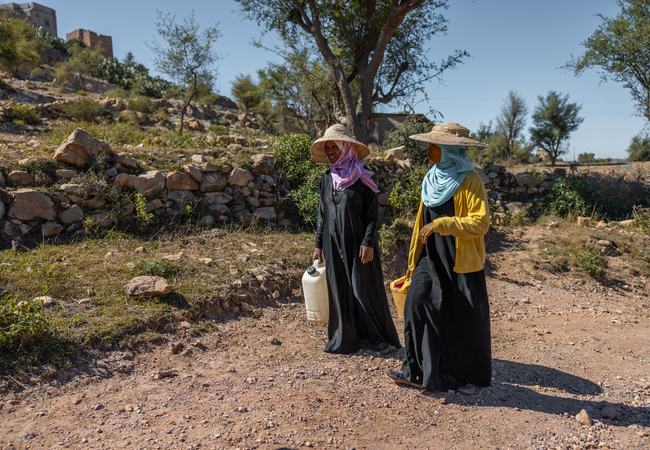
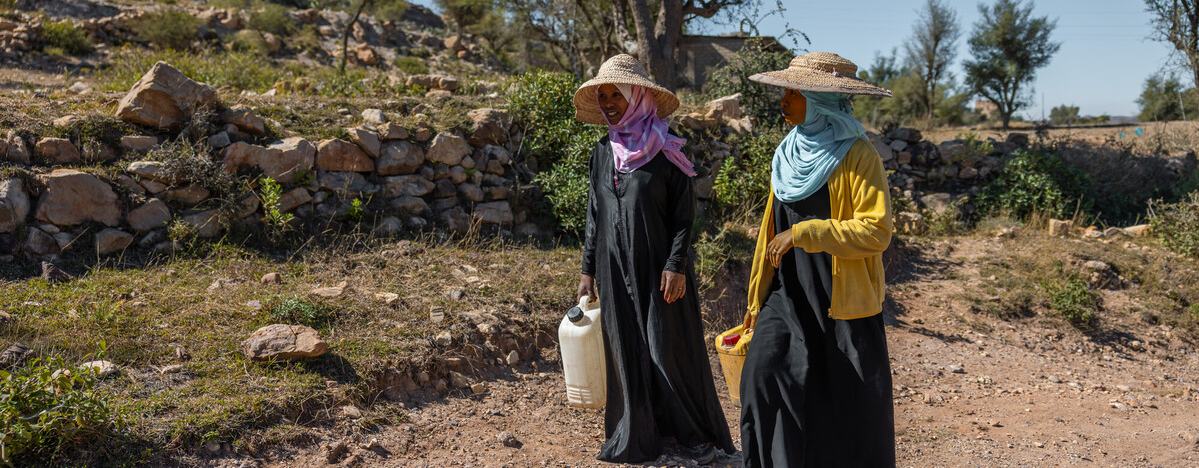
Before Oxfam's intervention, Abeer and her sister would carry empty water containers, passing long distances and climbing steep hills under the sun determined to provide safe, clean water for their families. Photo: Ahmed Al-Basha / Oxfam Intermón
With solar-powered water systems, our bills are halved, and water reaches our homes without delay.”
Abeer, Taiz, Yemen
Water is an essential and basic need, yet billions of people still lack reliable access to it. As the climate crisis intensifies, water security is needed more than ever for communities around the world who are experiencing droughts, floods and failing water systems that threaten health, livelihoods and safety.
We explore why water security is now one of the most urgent global challenges, and how Oxfam and partners are working with local communities to create long‑term, sustainable solutions.
Share this page
World Water Day: 22 March
After the three decades World Water Day has been marked, we've reached a point of emergency. United Nations scientists have made it clear that the world has entered an "era of global water bankruptcy,” where ecosystems are degrading faster than they’re recovering and formerly reliable water sources can no longer be counted on.
The urgency of the crisis is spelt out in three stark statistics:
2/3
of the world's population is experiencing severe water shortages each year.
2.2
billion
people are still without safely managed drinking water.
Oxfam recognises that the climate crisis is fundamentally a water crisis, as one is the consequence of the other, and human life cannot be sustained without it. Droughts collapse food systems. Floods wipe out homes and infrastructure. Rising seas salinise farmland and drinking water. Groundwater depletion lays waste to decades of development.
The provision of water has always been close to Oxfam’s heart. The water tanks and sanitation equipment we deploy to communities in the middle of crisis are resonant symbols of humanitarianism in action. Our partners are working across regions to provide long term and sustainable water and sanitation in some of the most inaccessible areas of the globe.
Hassan Siyad/Oxfam
This solar panel and water tank are part of the new water system installed by Oxfam in Ceel Afwayn, Somalia to ensure access to clean water by residents of the community.
Practical water solutions
To give a few examples, Oxfam is working:
in Somalia utilising desalination technology to provide clean water in arid areas for communities facing droughts and floods;
with partners in Kenya to deliver clean water for populations in remote rural areas using innovative designs and financing;
and with the government in Yemen to design and implement a sewage system preventing waste from entering the ocean.
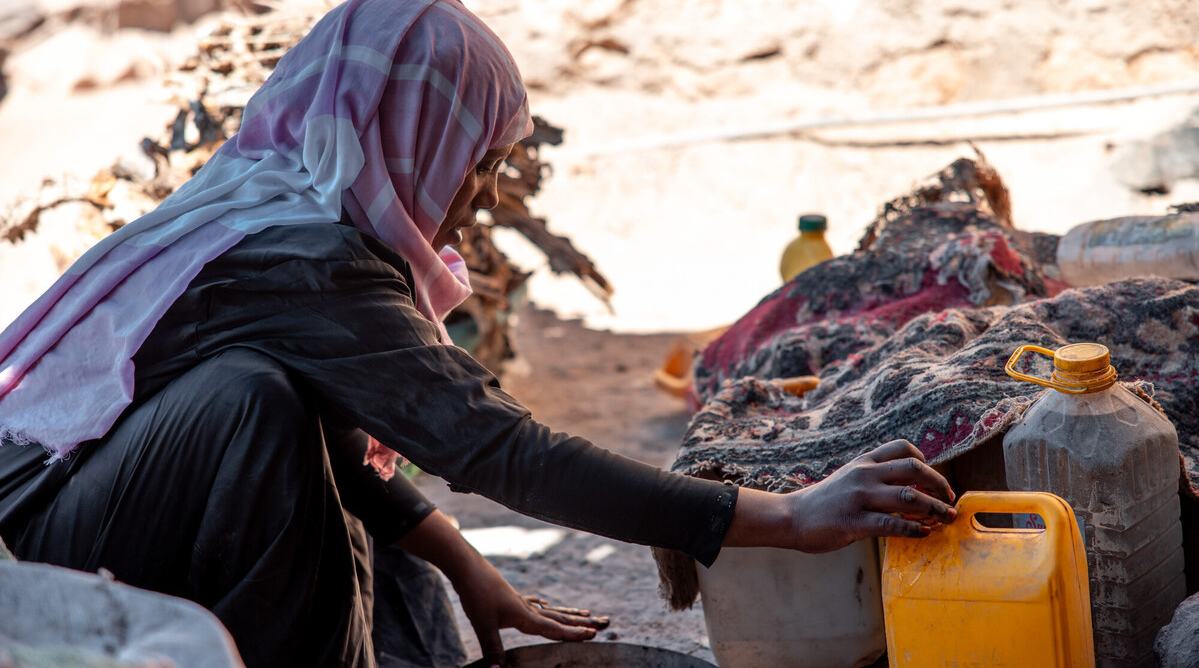
Ahmed Al-Basha / Oxfam Intermón
How water insecurity fuels inequality and hardship
For the 2.2 billion people still without safely managed drinking water, and the 3.5 billion without sanitation, each new shock compounds what is an already fragile reality.
Who is most affected?
Many of those most affected live in informal settlements, handling protracted crises, often in regions where governance is weak and infrastructure under-resourced. For them, climate change isn't a prophecy, but a clear and present daily reality.
The gendered impact of water insecurity
Existing inequalities and dangers, not least in relation to gender, are also exacerbated, with women and girls often expected to walk long distances for water, facing increased risk of assault and meaning they have less time for school and paid work.
What is the wider impact of water insecurity?
Water insecurity is the start of a vicious circle which:
Creates conflict between host communities and displaced people;
Increases disease outbreaks, including cholera and other waterborne illnesses;
Deepens food insecurity, driving malnutrition and poverty;
Pushes communities into displacement, as crops fail and livelihoods collapse;
Can all too easily be weaponised in some conflicts with occupying forces limiting or cutting off entire water supplies.
When water fails, entire economies are soon impacted.
How water challenges undermine livelihoods
Globally, water insecurity is draining productivity, undermining jobs and destabilising supply chains. The knock-on effects are clear:
Frequent droughts and floods are disastrous for crops and livestock;
Unreliable water access reduces labour productivity and economic participation;
Poor sanitation leads to illness, reducing workforce capacity;
WASH infrastructure disruptions increase health costs and emergency needs.
Climate finance must prioritise fragile communities
Despite the enormous cost of inaction, climate finance is all too often in short supply where it is needed the most. The inequality is manifest in Climate Finance Per Capita, with $8.80 being allocated to tackling the issues in fragile states against $161.70 in non-fragile states.
In short, the global system currently in place funds stability, not vulnerability, and yet instability is precisely where resilience must be built.
A turning point for global water action
However, all is not lost and this year’s World Water Day, instead of being a time to reflect on what has gone wrong, should be the moment to commit to putting things right.
The world is crying out for bold financing for water security – especially in fragile and conflict-affected settings – and the year ahead offers a real opportunity to break the cycle – not least with the World Bank's Mission Water, the UN Water Conference and the UK Government's aid review all now in progress.
Dania Kareh/Oxfam
An Oxfam team member checks on the water quality of the tanks installed in different neighbourhoods in rural Deir Ez-Zor, Syria in response to the needs of displaced people and to the host community.
It is heartening that water security is already beginning to be achieved in places like Somalia, Yemen and Syria. Yet there is still a great deal more to do to build understanding that water security for all is the only way to achieve security for all.
Strengthening communities by investing in water security
Investing in water security where it is needed most also, unarguably, makes good economic sense. Every dollar spent on anticipatory action, early warning, and resilient water governance avoids many more having to be found for humanitarian response.
“
Our lives have transformed, water is now accessible at home. Thank God we no longer have to exhaust ourselves carrying water from the wells.”
Abeer, Taiz, Yemen
Investment in water systems – whether community water points, transboundary cooperation, risk-tolerant adaptation finance, or nature-based water management – makes sense since it:
Stabilises communities;
Prevents conflict;
Protects women and girls;
Reduces forced displacement;
Maintains economic productivity;
Enables climate resilience from the ground up.
A call for action on World Water Day
If World Water Day is to mean anything at all this year, it has to be a call for action for the funding to be found for those who need it the most. The world's most fragile communities cannot afford to wait any longer.