Oxfam

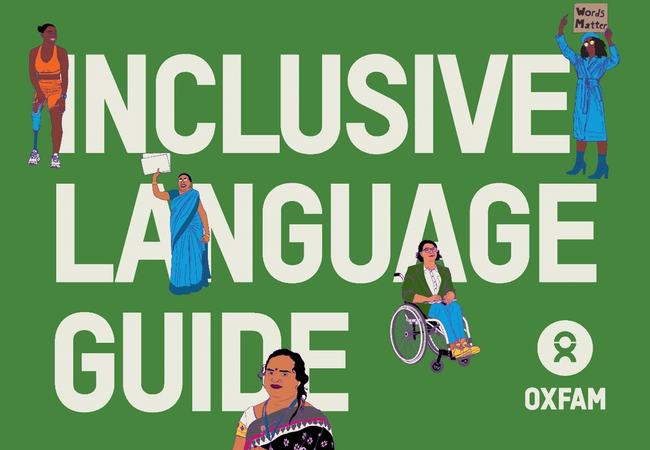
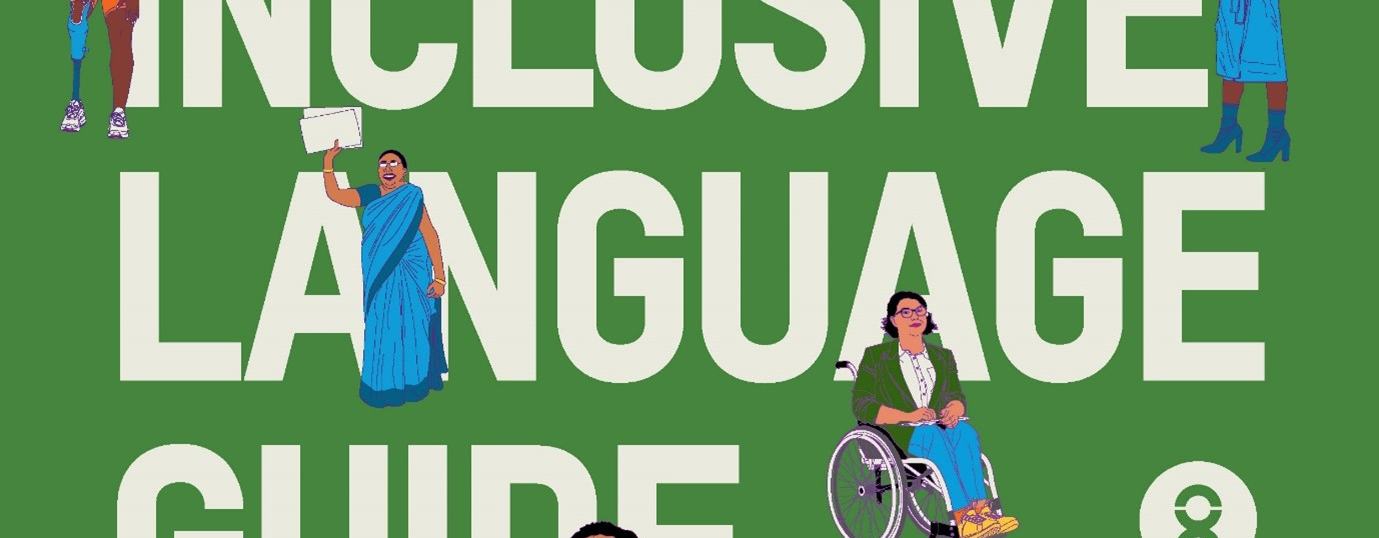
The cover of Oxfam's inclusive language guide which has a green background with the Oxfam logo and the title in white capitals. There are 5 illustrations of a diverse group of people including an athlete with a prosthetic leg and a person wearing a sari.

Oxfam launches its Inclusive Language Guide

Language shapes how we understand the world and the people we share it with. In international development, the words we choose can either reinforce harmful power imbalances or help challenge them. That’s why Oxfam has created an Inclusive Language Guide – to support more accurate, respectful and empowering communication across the sector.

This blog introduces the guide and explains why rethinking everyday language is an essential part of building a fairer and more inclusive future.

The power of words and why they matter

Why should people working in ‘international development’ care about the words they use?

The short answer is that language has power, in particular the power both to oppress and to liberate.

In the past, Oxfam and our peers in the sector have been guilty of ‘white saviour’ narratives, with the words we use reinforcing stereotypes about the people we work to support. This was wrong, and we are learning from decolonial activists to change that.

Making conscious choices in language can reframe issues, rewrite tired stories, challenge problematic ideas and build a radically better future based on a survivor-centred, intersectional, anti-racist and feminist vision of equality.

Oxfam

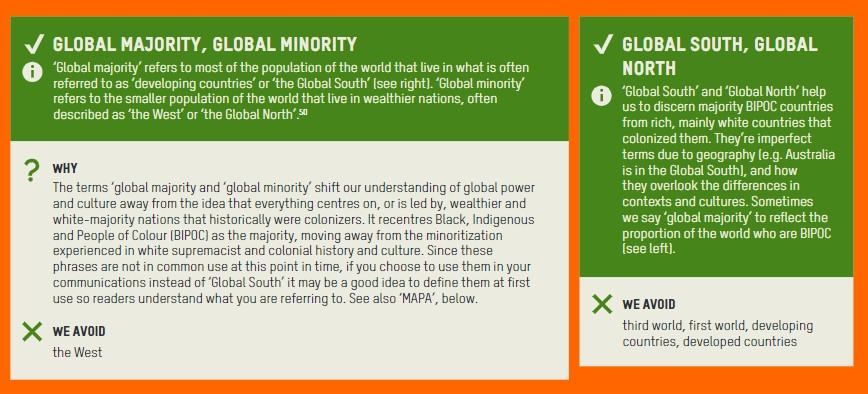
An excerpt from the inclusive language guide explaining alternatives to the term 'developing countries' i.e 'global majority', 'global minority', 'global north' and 'global south'.

An excerpt from the Inclusive Language Guide looking at alternatives to the term “developing countries”.

Inclusive language supports respectful and accurate representation

Also, not knowing which words to use can itself be a problem that can reinforce inequality. For example, many people want to write in a way that is inclusive of LGBTQIA+ people, but are not sure of the language preferred by those people and communities (see below) and don’t want to accidentally get it wrong – and so avoid doing so altogether.

That’s why at Oxfam we think it is so important that the language we use reflects our values and work and that is why we’re launching the Inclusive Language Guide, a resource to support people in our sector who have to communicate in English.

What is the Inclusive Language Guide?

The guide is a free resource to support people in our sector who have to communicate in English. It encourages the reader to think about how the way they write can subvert, or inadvertently reinforce, intersecting forms of inequality that we work to end.

The principles behind the guide

It is based on a set of feminist principles for language use that centre the power and agency of people experiencing inequality. It gives examples of how you can put these principles into practice in your writing and day-to-day conversation. It also includes phrases and concepts that we may not use much at the moment in our work and writing but which are important to understand in order to recognise and challenge intersecting power issues in our work.

Oxfam

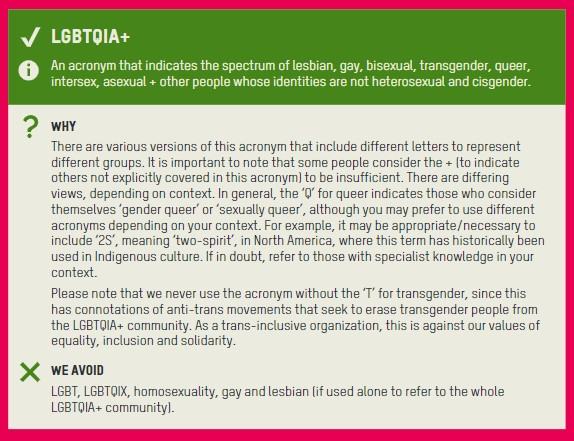
An excerpt from the inclusive language guide explaining the use of the abbreviation LGBTQIA+, why it is used and the terms we avoid using.

An excerpt from the Inclusive Language Guide looking at the use of the abbreviation “LGBTQIA+”.

Key themes and areas of focus

The new guide lists words and phrases that are relevant to ‘development’ INGOs, with an explanation of why we might use that word/phrase and might want to avoid other common words/phrases in the context of power.

It is structured in sections that span intersecting forms of inequality:

  • disability
  • physical and mental health
  • gender justice
  • sexual diversity and women’s rights
  • migration and the rights of refugees
  • race, power and decolonisation.

The language recommended is drawn from specialist organisations which provide advice on the language preferred by marginalised people, groups and communities, and by our own staff and networks. The aim is to support us to respect the way different groups wish to be referred to.

Understanding the limitations and complexities

While we hope this resource will be useful to people working in international development, and perhaps to social justice movements more broadly, we are well aware of the limitations and complexities around this project.

Learning from global majority movements

First, we recognise that radical and grassroots organisations and activists in the global majority have been leading work on racial justice and decolonisation for a long time. Oxfam is learning from these movements, and is in a process of recognition of the colonial history and behaviours of the ‘international development’ sector, with a view to working towards meaningful decolonisation of our work, and a shifting of power from the global minority to the majority.

In this project, we are led by the work of such specialist organisations and activists, whom we do not intend to replace or take space from, but to support, platform, and share power with in solidarity.

Oxfam

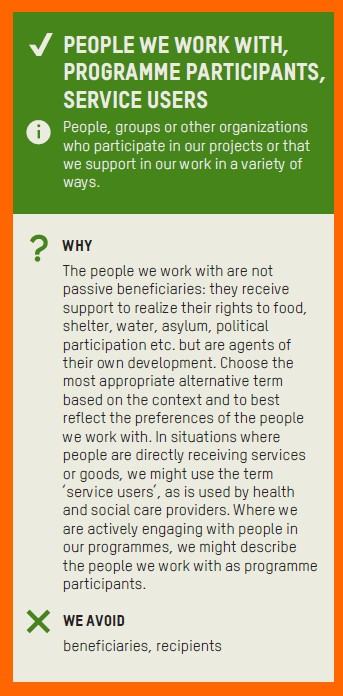
An excerpt from the inclusive language guide suggesting alternatives to the term 'beneficiaries' and recipients i.e 'people we work with', 'programme participants', 'service users'.

An excerpt from the Inclusive Language Guide suggesting alternatives to “beneficiaries”.

Navigating the dominance of English

Second, we recognise that there is a problem with the guide being all about English. We recognise that the Anglo-supremacy of the sector is part of its coloniality.

This guide is supporting people who have to work and communicate in the English language as part of this colonial legacy but we also understand that the dominance of English is itself one of the key issues that must be addressed in order to decolonise our ways of working and shift power.

Part of a wider shift toward justice and decolonisation

Third, we are conscious this is just one step in working towards Oxfam embracing an intersectional feminist and anti-racist approach to gender justice, and to all of our work that addresses the erasure of the voices and stories of women, racialised groups, people with disabilities, LGBTQIA+ people, and others.

It needs to be understood as one piece of a much broader effort to rethink and re-imagine how international development works to decolonise and shift power that includes initiatives backed by Oxfam such as the Pledge for Change.

An important resource that will continue to evolve

Finally, of course we recognise that this guide will inevitably be imperfect, that there will be alternative views and objections about the language we recommend, and that there will be questions about all of this. We welcome these so do please take a look at the guide and tell us what you think.

This publication is very much a work in progress, and a contribution at a particular moment to the work of decolonization and efforts to foster diversity and inclusion in INGOs.

We will review and update the guide as we learn and understand more, and to keep up with the evolving work of the social justice movements that have inspired it.