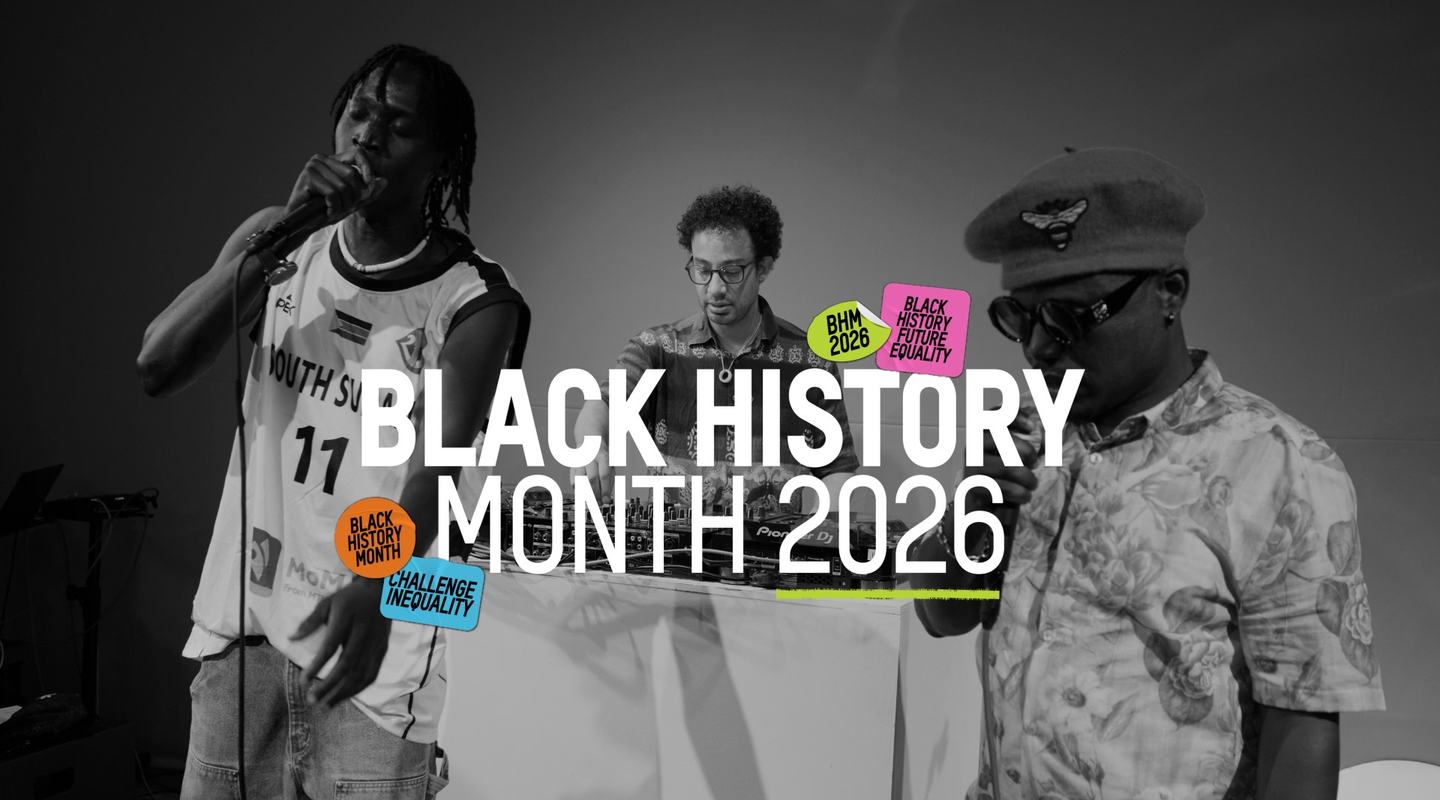
Black and white photograph three men performing a song. One is a DJ at his decks and two are stood in front holding microphones to their mouths. The text over the image reads Black History Month 2026

Fatima Mian / Oxfam

There are some people who are going through a lot, and they need help … maybe someone has never heard about South Sudan before, or about Sudan, or Congo. But they will.”

Gatkuoth Wan, South Sudanese rapper

Black History Month 2026

Black History Month is a time to celebrate and reflect on Black history, culture, communities and achievements – from those who changed history to those making it today.

This October, we’re celebrating Black Joy, creativity and community, while also asking why some Black communities and their experiences receive less attention than others.

Around the world, humanitarian crises affecting millions of people are being overlooked, under-funded or absent from the headlines. And those so often overlooked are taking place in Sudan, South Sudan and the Democratic Republic of Congo (DRC).

These inequalities don’t happen in isolation. They are shaped by decisions about whose lives are valued, whose voices are listened to and where money and political attention go. When these inequalities specifically disadvantage Black people and communities, we call this anti-Blackness.

There are some people who are going through a lot, and they need help … maybe someone has never heard about South Sudan before, or about Sudan, or Congo. But they will.”

Gatkuoth Wan, South Sudanese rapper

What is Black History Month?

Black History Month is an annual celebration of Black history, culture and achievement.

The first Black History Month in the UK took place in October 1987, 150 years after the abolition of slavery in the Caribbean. It was organised by Ghanaian-born activist Akyaaba Addai-Sebo, who wanted to challenge racism and celebrate Black history.

Today, Black History Month gives us an opportunity to recognise Black people and communities who have shaped Britain, celebrate Black culture, and learn about histories that have too often been overlooked.

It’s also a chance to recognise the history being made around us now. Events, exhibitions, talks, performances and celebrations take place across the UK throughout the month.

“

If a race has no history, if it has no worthwhile tradition, it becomes a negligible factor in the thought of the world, and it stands in danger of being exterminated.”

Dr Carter G. Woodson, American academic and historian widely recognised as the father of "Black history".

Why is Black History Month in October in the UK?

When the first UK Black History Month was organised in 1987, October was chosen partly because it was traditionally a time when African leaders gathered to discuss important issues, and partly because it came near the beginning of the school year.

Black History Month has been marked in October in the UK ever since. This differs from the USA where Black History Month is celebrated in February.

Why do we celebrate Black History Month?

Black History Month creates space to celebrate Black:

  • culture
  • identity
  • creativity
  • community
  • joy

It recognises the contributions Black people have made to Britain and brings greater attention to stories that haven't always been part of mainstream accounts of British history.

But celebrating Black achievement also means understanding the challenging circumstances in which those achievements were made. Throughout history, Black people have faced laws, policies, institutions and economic structures that have treated them unfairly or denied them the same opportunities as others.

Those inequalities haven’t simply disappeared. Around the world today, Black communities continue to experience their effects. The specific ways Black people and Black communities are dehumanised, devalued and systematically marginalised are referred to as anti-Blackness.

Black History Month gives us an opportunity to celebrate Black lives in all their fullness, while also providing an opportunity to reflect on those challenges Black communities continue to face today, and the systems that shape those experiences.

What is the theme for Black History Month 2026?

This year’s official theme, set by blackhistorymonth.org.uk, is ‘Honouring Our Communities: Celebrating those who shape communities every day’. It celebrates the people whose everyday contributions shape the communities around them, including people whose names may never appear in a history book.

Oxfam shops and volunteers in our communities will be putting on their own Black History Month activities such as window displays. But, honouring communities also means listening to them. It means celebrating Black Joy, creativity and achievement. It also means recognising how histories of colonialism, racial injustice and inequality continue to shape whose experiences are heard.

Who gets heard matters. Decisions about which stories make the news, which crises receive political attention and ultimately what funding and support is delivered can have real consequences for people’s lives. And these decisions don’t happen in a vacuum – they’re shaped by inequalities that have developed over generations.

One of these inequalities is anti-Blackness, a specific form of racism directed towards Black people. Anti-Blackness devalues Black lives and experiences, contributing to whose voices are heard, whose suffering is recognised, and whose communities receive attention and support.

Understanding how anti-Blackness operates is essential to tackling poverty, inequality and humanitarian injustice.

Why do some humanitarian crises go unheard?

Millions of people around the world are living through devastating situations. But we’re not hearing the full story due to reduced media coverage, funding or political attention.

Crises affecting people in Sudan, South Sudan and the Democratic Republic of Congo (DRC) are too often overlooked. With fast-moving and increasingly fragmented media, our attention is constantly being pulled in different directions. It can be difficult for any humanitarian crisis to break through. But too often, it is the same stories and communities that are sidelined or overlooked.

There are many reasons why a humanitarian crisis becomes hidden or unheard, where governments focus their attention, and where funding goes can all shape which crises the world hears about. It’s often because of choices being made. Some stories simply aren’t prioritised. Some aren't in the interests of those in power. Some stories threaten the system itself. These choices can also be influenced by deeper inequalities that have developed over generations. Understanding why means looking at the inequalities that influence whose stories are valued in the first place.

In some cases, anti-Blackness can influence how crises affecting predominantly Black populations are perceived and prioritised. While every humanitarian emergency is different, understanding these underlying inequalities can help explain why some crises receive sustained attention while others remain under-reported and under-funded.

Take action this Black History Month

Black history shows us the power of people refusing to accept silence. It can also help us recognise the inequalities shaping whose voices – and whose crises – receive attention today.

“

You have to act as if it were possible to radically transform the world and you have to do it all the time.”

Angela Davies, Feminist, Activist, Author

This Black History Month, add your voice to our petition to the UK foreign secretary, help break the silence and call on the UK government to do more to support communities facing humanitarian crises.

Glossary of terms

Anti-Blackness, anti-Black racism

The Movement for Black Lives defines anti-Blackness as racism towards Black people specifically, "which voids Blackness of value while systematically marginalising Black people and their issues." This can take the form of overt racism and it also refers to the "covert structural and systemic racism that predetermines the socioeconomic disadvantage that Black people experience."

Colonialism

Colonialism is the domination of one country by another through violence – to gain political control, occupy the land with settlers and exploit it economically. Many people may feel this no longer exists. But the domination over different countries’ cultures, languages, religions and economies still remains.

Racial injustice

Racial injustice is the systematic unfair treatment of people because of how their race is perceived by the society in which they live. Centring racial justice is essential in the work to tackle poverty and inequality.

Structural racism

A system in which public policies, institutional practices, cultural representations and other norms work in various, often reinforcing ways to perpetuate racial group inequity.