An aerial view of a winter city surrounded by snowy mountains, with bright sunlight casting long shadows across buildings and slopes.

Photo: Ollie Craig

What is Davos and the World Economic Forum?

Every year, there is a meeting that many people call ‘Davos’ – but 'Davos’ actually refers to an Alpine town in Switzerland. 

What they’re really talking about is the World Economic Forum’s (WEF) annual meeting that’s hosted at this Alpine resort. It brings together political leaders, business executives, academics and others to discuss critical global economic and political issues.

The WEF was founded in 1971 and was created to promote cooperation between governments and the private sector, but has no formal government or legislative authority.

It convenes power brokers and has significant influence over the future of our economies. It’s highly exclusive and can be attended by invitation only, hence why media often report on it as ‘a meeting of the global elite’.

Also in this section

Why does Davos matter?

‘Davos’ is a major influential global meeting, staging debates on inequality, climate change, and the global economy, as well as many closed-door and private conversations amongst attendees.

Lots of people and critics argue that this meeting only reflects the interests of the world’s wealthiest and most powerful individuals, institutions and companies, rather than the needs of the majority who are most impacted by the issues on the agenda. And that’s why, every year for the past decade, Oxfam attends to speak truth to power and to represent the lived reality of everyday people, and especially people living in poverty.

Outside the meeting, Oxfam releases a paper and a campaign to shine a light on the true state of global economics and the injustice of economic inequality.

When is Davos?

The World Economic Forum Annual Meeting takes place every January in Davos, an Alpine resort town in Switzerland. In 2026, the Davos meeting is held between 19th and 23rd of January. 

What is the Davos agenda?

Most years at the WEF meeting, the Davos agenda focuses on major global challenges such as economic growth, global inequality, climate breakdown, and conflict.

As this is one of the largest gatherings of world leaders, corporate executives and institutions, the meeting provides a space to influence global economic direction.

The conversations influence direction on a wide range of issues that impact our everyday lives – from affordability and labour rights to the future of technology and energy.

What’s on the agenda for Davos 2026?

For the World Economic Forum, the official Davos agenda for 2026 centres around 'A Spirit of Dialogue', reflecting growing concerns about global instability, widening inequality, and the climate crisis. Discussions are expected to focus on how to respond to these interconnected challenges.

Photo credit: Ministério da Indústria, Comércio Exterior e Serviços from Brasília, Brasil. https://creativecommons.org/licenses/by-sa/2.0/

A Spirit of Dialogue

For Oxfam, the 'Spirit of Dialogue' agenda highlights the urgent need for fairer economic systems that prioritise people over profit and tackle the huge concentration of wealth among the richest.

It’s time for the power brokers who attend Davos to not simply talk about these issues, but take action to combat them.

Who attends Davos?

Davos is attended by heads of state, government ministers, CEOs of multinational companies, economists, academics, and the media. These people have massive power to shape and change our world.

Some Civil Society Organisations (CSOs) are also invited to attend. Oxfam International is one of those CSOs. Every year, we call out extreme wealth inequality and the dominance of super-rich individuals and corporations over most people’s lives.

By being ‘in the room’, we challenge participants to address poverty, inequality and climate justice. We help to put the people affected central to discussions dominated by powerful economic interests.

Photo credit: World Economic Forum/Boris Baldinger. https://creativecommons.org/licenses/by-nc-sa/2.0/
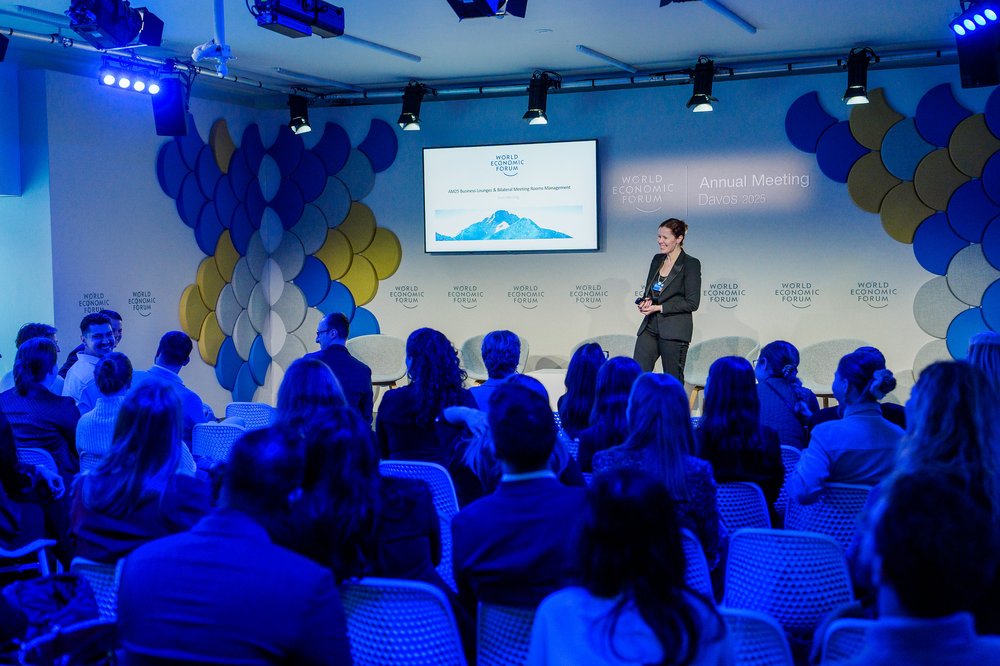
An audience seated in a conference hall watching a presentation at the World Economic Forum Annual Meeting in Davos, 2025.

During Davos 2025, Oxfam highlighted how extreme wealth continues to grow. No matter how much technology you have, millions struggle to afford basic needs.

What impact does the Davos meeting have?

This meeting doesn’t produce binding agreements, communiques, or policies, but it does have a huge impact in the world.

The Davos meeting plays a powerful role in shaping the future of our economies and society. The ideas discussed influence corporate strategies and government priorities worldwide long after the event ends.

What is the Oxfam Davos report?

Each year, Oxfam publishes its Inequality report to coincide with the Davos WEF Annual Meeting. The report exposes the scale of global economic and wealth inequality, revealing how economic systems continue to benefit the super-rich at the expense of the many.

Over 10 Years of Oxfam Davos reports

The Oxfam Davos report is eagerly awaited every year, and we have been producing these papers for over 10 years.