Three years of brutal war have created one of the world’s largest humanitarian crises.

Sudan Regional Crisis Appeal

Three years into Sudan’s brutal war, the conflict has forced millions of people to flee their homes, creating one of the world’s largest humanitarian crises. Many have fled the crisis in Sudan to seek refuge in South Sudan and Chad, and this is straining already scarce resources.

The looming rainy season, combined with aid cuts by the UK and other key donors, has severely restricted humanitarian efforts, putting millions of lives at risk.

Now, neighbouring countries like South Sudan are in the midst of a catastrophic humanitarian crisis. Over 5.9 million people are facing high levels of acute food insecurity and need urgent humanitarian assistance.

What's happening in Sudan?

The conflict in Sudan has forced millions of people to flee to neighbouring countries. This is deepening humanitarian needs and worsening food insecurity, not only in Sudan but also in the wider central and eastern African region.

Malnutrition levels are rising, with children and pregnant women among the most vulnerable. The situation is especially dire for displaced families – 90% aren't able to afford even one meal a day.

As people are forced from their homes, they lose their possessions, crops and income, and often get stranded in places where there aren’t enough facilities to support tens of thousands of new arrivals.

The refugee crisis in South Sudan and Chad

Chad and South Sudan, two neighbouring countries that each host over a million refugees and returnees, are already facing severe hunger crises. The arrival of people fleeing Sudan’s conflict is adding further strain to limited resources, worsening these fragile situations.

What’s happening in South Sudan?

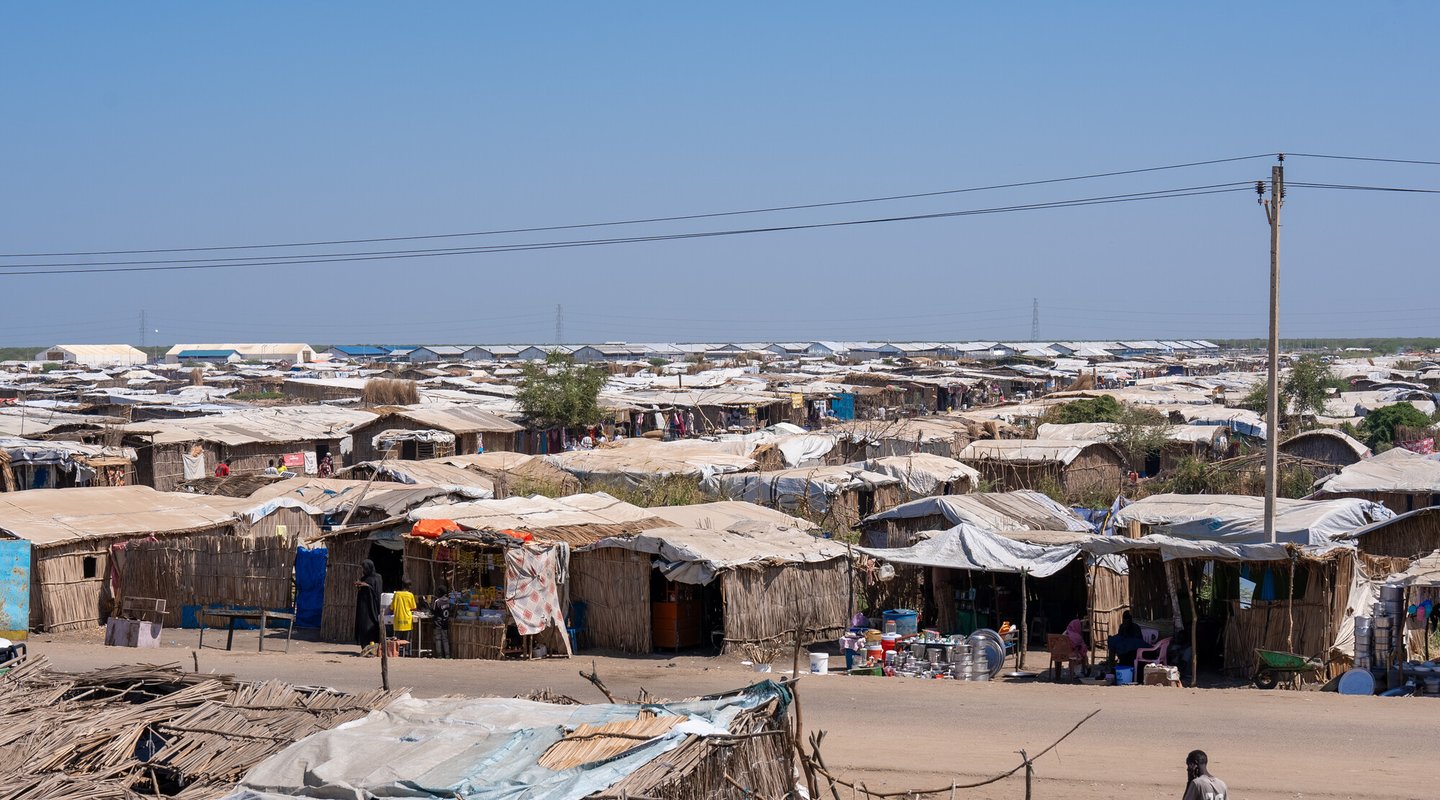
More than 1.3 million people have fled Sudan into Renk, South Sudan. The arrival of people fleeing Sudan's conflict is increasing pressure on services and supplies in South Sudan, fuelling local tensions and putting the country's fragile peace at risk.

In April 2026 alone, close to 10,000 individuals crossed into Renk, arriving at transit centres seeking refuge.

What’s happening in Chad?

Since the war in Sudan began in April 2023, more than 926,000 people have arrived in eastern Chad fleeing the violence. In April 2026 alone, 22,791 refugees were registered.

With resources already stretched, there are growing concerns that more people will flee to Chad in the coming months.

How is Oxfam responding to the refugee crisis in the region?

Oxfam does not have a presence in Sudan. Together with our partners, we have been responding to the refugee crisis in South Sudan and Chad to deliver humanitarian aid to help people affected by the conflict in Sudan.

Oxfam and partners are supporting people with:

  • Clean water, sanitation facilities and hygiene support. This includes safe drinking water systems, latrines, hygiene kits and promoting good hygiene practices to help mitigate infectious diseases such as cholera.
  • Multi-purpose cash assistance so people can access what they need most, such as food and other everyday essentials.
  • Providing essential items and support for women and girls. In Renk, South Sudan, we're providing menstrual items, dignity kits and solar-powered flashlights to help improve security for women. In Chad, Oxfam and partners are raising awareness on the rights of refugees, monitoring and referring gender-based violence (GBV) cases, and providing financial support for GBV cases.

Photo credit: Herison Philip Osfaldo/Oxfam

When Oxfam helped me, I stopped going to the forest and started a small business to support myself with the cash assistance I received.”

- Shaima Ali in Renk, South Sudan.

Shaima, a mother of four who fled conflict, used Oxfam’s cash assistance to start a charcoal trading business and buy clothes for her newborn daughter, Fatima.

The humanitarian crisis in Jonglei State

Jonglei State in South Sudan is also facing a worsening humanitarian crisis, caused by increasing conflict between communities.

Since December 2025, renewed fighting between the Sudan People’s Liberation Movement-in-Opposition (SPLA-IO) and the South Sudan People’s Defence Forces (SSPDF) has forced more than 300,000 people to flee their homes.

Violence, displacement and hunger are all continuing to rise.

What's happening in Jonglei State?

  • Escalating violence: Jonglei State is facing a rapidly worsening humanitarian crisis driven by intercommunal conflict, including cattle raiding, revenge killings, and territorial disputes, particularly in Akobo County.
  • Mass displacement: Over 304,770 people have been displaced since April 2026, mostly within Jonglei, while many others are fleeing to neighbouring states and around 100,000 crossing into Ethiopia.
  • Severe living conditions: Displaced families are sheltering in bush areas and wetlands with little or no access to food, clean water, healthcare, sanitation, or protection services.
  • Increased risks for women and children: Women and children face higher risks of gender-based violence, family separation, and disrupted education, as schools across affected areas remain closed.
  • Rising food insecurity: An estimated 7.8 million people are expected to face acute food insecurity between April and July 2026, including 73,300 in catastrophic conditions (IPC Phase 5).

How is Oxfam responding in Jonglei State?

Despite the huge challenges due to insecurity, Oxfam and its partners are responding wherever access is possible.

This support includes:

  • Distributing food to affected populations
  • Supporting emergency health services to mitigate the spread of infectious diseases such as cholera
  • Delivering protection and relief items, including hygiene promotion and non-food supplies, alongside services that address immediate needs and reduce vulnerability among displaced populations
  • Giving cash assistance to support households with their essential needs.

Photo: Herison Philip Osfaldo/Oxfam

We were hiding but when the war reached us, I had to take my children and escape. Now as a refugee in South Sudan, I get a monthly cash assistance, buckets, dignity kits, and soap from Oxfam which has continued to help me since my arrival. But with a family of six, I would want to do more to feed my children.”

- Ayul Ajak.

Ayul, who is visually impaired and a mother of six, plays with her child outside her temporary home in Renk, South Sudan.

After fleeing Sudan with her children and sister, Ayul is working to rebuild her family’s life despite the challenges of displacement.

How your donation will help Sudan

Most people who manage to escape conflicts can't bring much with them.

So, when they reach a safer place, they need secure shelter, and non-food items including household and kitchen sets, water and sanitation items, and food. People fleeing conflict have the right to be provided with protection and safety.

As part of the ongoing response, Oxfam and local partners have already reached thousands of families with clean water, food and basic essentials.

Your support will help us and our partners keep reaching the thousands of refugees arriving every day who are in urgent need of humanitarian assistance.

Please donate what you can today to help us continue our response.

How we spend your donation

For every £1 you donate to this emergency appeal, we will allocate 9p of your donation to cover general support and running costs.

There is a small chance that we will raise more money than is needed for this appeal. If this happens, we’ll spend any additional funds on other Oxfam projects – wherever the need is greatest.

Overview of the Renk transit center that is hosting hundreds of thousand of people fleeing the conflict in Sudan.

The Renk transit center that is hosting hundreds of thousand of people fleeing the conflict in Sudan. Photo credit: Herison Philip Osfaldo/Oxfam.

Donate now