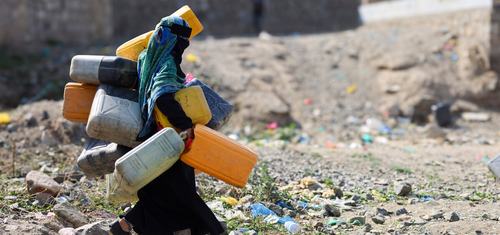
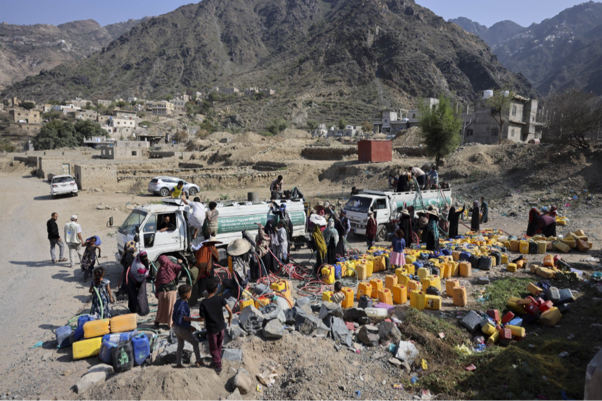
These are the words of 34-year-old Rahma, a farmer from the Sabir Al-Mawadim district of Taiz. Her plea speaks to a structural emergency, not a temporary shortage. Across Taiz governorate, clean water scarcity has become a bitter and exhausting daily struggle for survival.2 Located in southwestern Yemen, Taiz is one of the country’s most populous governorates and has endured years of conflict that have divided communities and disrupted essential infrastructure, including water networks. Years of conflict, damaged public infrastructure, economic decline and climate-related shocks have eroded development gains.
The crisis in Taiz reflects Yemen’s wider water emergency. World Bank data show that Yemen had only around 55 cubic metres of renewable internal freshwater resources per person in 2022, compared with a global average of roughly 5,400 cubic metres, around one per cent of the global figure. The collapse is visible across both Taiz city and rural valleys. In Taiz city, the public water system has been severely weakened by years of lost or restricted access to key water fields, which once supplied around 20,000 cubic metres a day. Public network coverage is now below 29 per cent, and more than 600,000 people in the city need safe, reliable water and sanitation services. The wider governorate also has a large returnee population: IOM recorded the presence of 783,181 returnees across accessible areas of Taiz in April and May 2026.
This displacement dimension places further pressure on already weakened water systems. Taiz recorded the largest returnee population among accessible Government of Yemen-administered governorates in IOM’s April–May 2026 assessment. Many families are therefore attempting to rebuild their lives in communities where water networks, agricultural livelihoods and basic services are already severely strained. Water insecurity can also contribute to further movement when wells fail, farmland becomes unproductive and families can no longer meet their basic needs. The water crisis is therefore not only an infrastructure challenge, but also a humanitarian and protection concern.
With the public system unable to meet demand, many families depend on private water sellers. A 5,000 litre water truck costs around 90,000 to 100,000 Yemeni rials. At the April 2026 average exchange rate in Government of Yemen-controlled areas, this was roughly US$58–64. For Nabil, a retired teacher whose pension barely covers rent and basic living costs, that price is simply unaffordable.
The Unbearable Weight on Women and Girls
As water scarcity worsens across Yemen, women and girls often carry the greatest physical and psychological burden of collecting water, while facing heightened safety and protection risks.
In the Al-Dbab valley basin, reduced rainfall and unsustainable groundwater extraction have contributed to the drying of agricultural land. Farmers, including women such as Rahma, have lost crops and income.
In Al-Sayahi, Sabir Al-Mawadim, Rahma supports a household of 11, including eight children and an aunt with a disability. The loss of water halted her family’s cultivation of okra, zucchini and tomatoes, cutting off their main source of income.
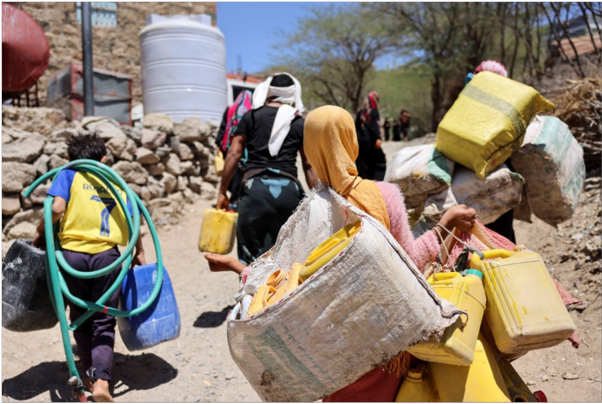
Her family needs about 15 jerrycans of water each day for drinking and household use and makes three or four exhausting trips to collect it. Rahma’s severe back pain means she can barely carry one jerrycan, leaving much of the burden to her children, including nine-year-old Ramla and eight-year-old Rimal.
They sometimes leave before dawn or late at night to avoid the heat and crowds. The mountainous journey in darkness exposes the girls to risks, including stray dogs and other animals.
Education Sacrificed for Water