Hjalmar Haagsman / Oxfam Novib

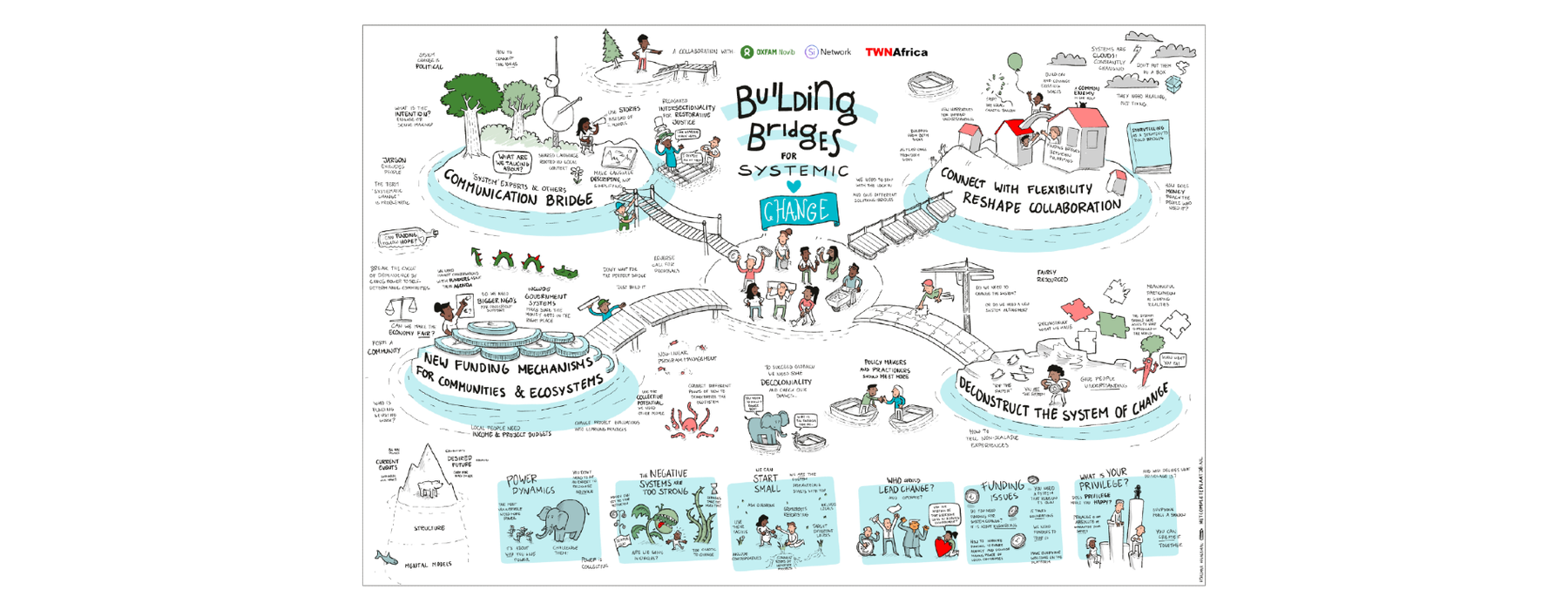
An illustration of four little islands representing the changing systems of power: communication, collaboration, funding and deconstruction of the system. Each one is connected by bridges to a fifth island where a group of people are working together.

Exploring the future role of INGOs

Sucharita Iyer and Sydney Cohee

13 Oct, 2026 / 4 mins read time

The topic of systems change, and the role of large INGOs such as Oxfam, was explored in a program of work which concluded in 2025 with the Oxfam Novib event Building Bridges for Systemic Change. Conversations at the event covered the complex topic of upholding and maintaining existing systems of power and privilege, while also seeking to transform them.

This blog outlines some of the big learnings around systemic change for INGOs and what a different future for us might look like as we move towards more integrated, collective systemic transformations.

Discussing systems change at the “end of the NGO era”

In 2025, Oxfam Novib and collaborators in Amsterdam held the event Building Bridges for System Change which gathered together changemakers and innovators from across the European development ecosystem.

The event was the culmination of a systems change learning trajectory within the FAIR for ALL program in which Oxfam Novib, our collaborators and our partners across the international development sector have sought to understand what systems change means for us in practice.

A much used and rarely understood term, systemic change has become the buzzword for:

  • civil society
  • philanthropy
  • government
  • academia

Therefore, we’ve continued to wonder: how can we bring together people with rights, interests, and power to develop an integrated, collective, and practical approach for lasting systemic transformations?

As many claim that the ‘golden age’ of Global North international non-governmental organisations (INGOs) is coming to an end, this is an important time for us at Oxfam to deeply reflect on what systems change means for INGOs like us in the future.

“

INGOs are afraid to become irrelevant... this risks [us] blocking revolution and upholding the status quo.”

Participant of Building Bridges for Systemic Change in 2025

What lessons were learned?

Lessons that emerged through the learning trajectory and the event indicate that in a deeply connected global system in which decisions and actions made in one place have ripple effects on others, INGOs do not need to become irrelevant, they must become relevant in different ways.

While we continue to engage in and facilitate discussions on systems change frameworks at all levels, we are seeing that the real transformation lies in us recognizing and amplifying the changes being driven by grassroots movements.

INGOs committed to decolonization may find themselves in an interesting position: they are simultaneously trusted both by alternative grassroots visionaries and by traditional institutions. This position can be a great asset: these INGOs can connect the revolution to the managers of the status quo, creating pressure, accountability, and opportunities for structural change that neither side could achieve alone.

So, while this may be an end of an era, it may also be the emergence of a connected civil society prepared to co-design a better future, one that is truly fair for all.

Considerations for the future

The future of systems change for large actors such as Oxfam Novib requires us to move away from how things have always been done and towards the uncharted and – hopefully – the exciting.

The practice will be imperfect, and that’s okay. As we continue to shape it with our partners and allies, here are some things to consider.

Power continues to shape who convenes and who decides

Community self-determination lies at the heart of systemic change and, while localization lies at the heart of current thinking, some grassroots leaders feel a disconnect in how knowledge continues to flow. Little has changed about how decisions are made, who makes them, and whose interests these decisions meet. A shift in the flow of knowledge means that communities lead critical insights to provide evidence for rights-based decision- and policymaking.

One speaker at the Building Bridges event noted that, “[…] we still need ‘powerful’ individuals to guide decision-making” – reminding us that there is much to be changed in terms of where power, resources, and decision-making are concentrated amongst development actors.

The responsibility of INGOs then is to resource women-, Indigenous-, migrant-led, and other community organizations and to amplify their calls for action. We must not simply create parallel safe spaces alone but also open the doors of existing institutions and demand that they become more inclusive, and, ultimately, invite institutional powerholders into new, alternative spaces. At its core, this work depends on trust and meaningful participation.

People must feel safe to speak, know they will be heard, and see their contributions translated into action rather than tokenized.

Urgency and long-term goals continue to co-exist

The long-term goal of systemic change requires multigenerational, future thinking in how we approach our actions. However, there remains the duality of the here and now, for example, where we continue to face urgent humanitarian needs. To do so, INGOs must acknowledge the duality between now and the future: this requires a shift in how we operate with trust and how resources are shared with local leadership of communities facing crises.

We must respond to urgent humanitarian needs while also using advocacy to challenge the structures that have created them – rather than only responding to crises, we must interrogate what created the conditions for them in the first place.

Diversity is our greatest strength

The conversations during our explorations of systems change reaffirmed that, to change systems, we need interdisciplinary, cross-geographical coalitions rooted in visions of justice. Through trust-based (and maybe unconventional) relationships, dialogues, and advocacy, we can both amplify diverse voices and interests, and build coalitions that can challenge power asymmetries, shift mindsets, and change policy.

INGOs represent a collection of:

  • storytellers
  • guides
  • weavers
  • experimenters
  • frontline responders
  • visionaries
  • builders
  • caregivers
  • disruptors
  • healers

Honoring these roles and connecting how they manifest in local actions to regional and global advocacy are key to creating change in multiple parts of the connected system.

We need less theory, and more relationships and action

Theoretical frameworks can be abstract, and while they are valuable, they miss the mark on how to truly and tangibly transform systems. As INGOs, the relationships we build and, as a result, the actions and changes that follow form the core of social and systemic change. As organizations that play a central role in global development systems, we must keep bridging theory and practice – avoiding the trap of endless abstraction that delays radical experimentation and progress.
And finally...

We recognize that a lot of conversations about systemic change – including at the Building Bridges for Systemic Change event itself – remain largely Eurocentric and risk upholding the status quo.

We want to continue having these conversations with those who are traditionally excluded from or underrepresented in these spaces, to ensure that we are building new and changing perspectives on how systems change and how we as individuals and civil society organisations (CSOs) can contribute to a fairer future.

About the authors

Sucharita Iyer

Sucharita is an Impact Measurement and Knowledge Specialist at Oxfam Novib. She focuses on feminist facilitation and qualitative research to support learning in programmes.

Sydney Cohee

Sydney is a Researcher and Impact Measurement Specialist at Oxfam Novib. She is also the author of a research paper on systems change, building on insights from practitioners beyond the international development sector.