
Marga RH

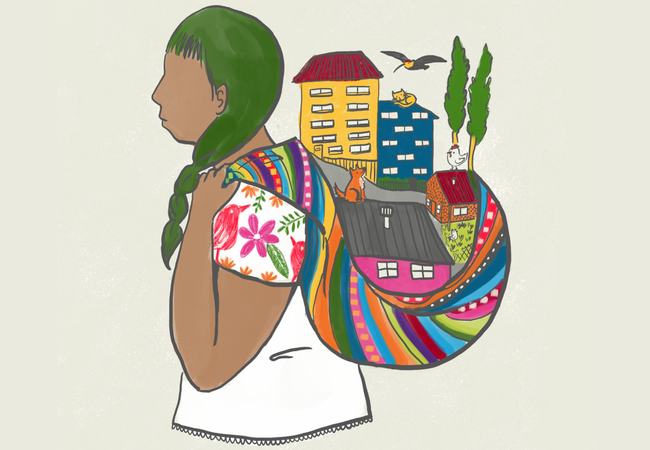
Illustration of a young person carrying a colourful, stripy, sling-type papoose on their bag filled with buildings and nature to depict carrying their community.

From control to justice: reframing migration

Sydney Cohee and Eleni Diker

2 Nov, 2026 / 5 mins read time

This blog accompanies Oxfam’s new discussion paper, Mobility Justice: A Framework and Vision for Human (Im)mobility. The paper introduces mobility justice as a framework to understand how power shapes people's choices and experiences of migration, and also as a vision to imagine systems that prioritize dignity, self-determination, and shared prosperity.

Join us in rethinking how we talk about migration, amplifying lived experiences, and working in solidarity across sectors to build new narratives around shared humanity and justice rather than control.

Why do we need a new migration narrative?

The way we think and talk about migration affects everyone:

  • people on the move are dehumanized.
  • people who stay in place in deteriorating circumstances are ignored.
  • societies are polarized.

Right now, people around the world are confronting intersecting crises: climate change, wars, economic instability, rise of authoritarianism and democratic backsliding. These crises are both the cause and the consequence of systematic violations of human rights and rising inequalities – thus we find ourselves in a vicious cycle of injustice.

Instead of calling out the structures that drive these crises, dominant narratives blame people on the move.

These narratives carry significant power and evoke real consequences for the treatment of migrants. They also affect society as a whole: they keep policies focused on the wrong "problem" and deepen divisions within and across borders.

Human mobility at the heart of the migration debate

Human mobility is a fundamental human experience. It is the ability to choose where to live, whether that means staying rooted in place or moving between villages, cities, or countries. It is lived both individually and collectively across multiple spaces, and ultimately reflects a basic right: the right to exist in one’s body, in public space, and across borders (See: Mobility Justice: The Politics of Movement in An Age of Extremes by Mini Sheller, 2018; and A theory of migration: the aspirations-capabilities framework by Hein de Haas, 2021 from the journal Comparative Migration Studies).

Yet, the capability to move and to stay – and to do so under safe conditions – is not equally enjoyed by all. While the movement and settlement of some people is promoted, guaranteed, and rewarded, others are denied, criminalized, and contained. Think about passport privileges: while some can travel as tourists with no visa restrictions, others navigate months of costly bureaucracy. Some travel and settle across borders and are called ‘expat’ while others, doing pretty much the same thing, are called ‘migrant’.

When such a fundamental human experience is not equally distributed, it becomes an issue of injustice. This is called mobility injustice.

Looking beyond individual blame

Migration is not a “problem to solve” but is an ordinary human experience that has been constrained, politicized, and dehumanized in order to protect a global system that prioritizes power and profit over people and planet. Harmful narratives are used to justify a system that concentrates power into the hands of a few.

Migration ... is an ordinary human experience that has been constrained, politicized, and dehumanized in order to protect a global system that prioritizes power and profit over people and planet.

Some people have freedom of choice and others have "choiceless choice"

When people have no real alternatives to choose from, their decision becomes a choiceless choice.

Oxfam’s new discussion paper builds on the work of scholars and activists to advance mobility justice as a decolonial framework for humanitarian and development practitioners.

Rather than asking why people move or stay, it asks how their choices and experiences are shaped by colonial systems of power. The framework centers people’s self-determination while exposing systemic factors that create conditions of choiceless choice, whereby decisions to migrate or stay are made without real alternatives.

Understanding the current system is the first step towards changing it

Applying the framework unveils that mobility injustice and choiceless choice are not symptoms of a broken system. They are both cause and consequence of a global economic system that has been designed with inequality at its core.

Built on persisting colonial, neoliberal, patriarchal, and white supremacist norms, today's global system allows money, companies, and goods to move freely, while people from the global majority face strict and systemic restrictions on their movement.

These inequalities are reflected and exacerbated, for instance, in the extractive practices and policies of financial and trade sectors, land grabs, and poor regulation of the arms trade – creating cycles of injustice before, during, and after people's migration trajectories.

Migration governance reinforces these disparities, for example, categories that label people as ‘forced’ or ‘voluntary’ migrants reinforce colonial/racialized hierarchies about who deserves to be welcomed and/or protected. And aid response risks further limiting people's ability to choose where and how to move or to stay. For example, aid is increasingly used to fortify borders and control migration rather than for its true purpose of fighting poverty.

Building vision and changing narratives are important steps to catalyze change

Narratives shape society, and society shapes narratives.

We have the power to change how migration is talked about, how the stories are written and by whom. This can shift perceptions and later inform a change in mindset, norms and policy to catalyze the co-creation of new systems designed to support prosperity for all.

A vision of mobility justice

Grounded in feminist and systems-change principles, mobility justice is more than an analytical lens. Its aim is to inform thinking and action for the dismantling of systemic forces which have made mobility a privilege rather than a collective right.

Mobility justice serves as a vision of what an alternative world could look like: a world in which everyone enjoys the right to move freely and the right to stay in their home, community, and land.

Marga RH

The discussion paper, Mobility Justice: A framework and vision for human (im)mobility questions why some people have real choices about where they live their lives, and others don't.

Read the discussion paper on Policy & Practice

So, let’s come together in solidarity as humanitarian and development practitioners to challenge our assumptions, reflect on our power, truly listen to people with lived experience, and be open to real change.

Changing the narrative on migration

This is a call to become more aware of, and make more visible, the consequences of our work – be it on climate, gender, economic or humanitarian justice – on people's ability to move or stay in place.

The overlapping crises we are trying to address and prevent cannot be truly confronted if we do not consider mobility justice. It helps us understand how they are produced, distributed, and managed by policy choices. It shifts attention from controlling movement to transforming the unequal systems that determine who moves, who is forced to move, who is unable to move, and who benefits from uneven mobilities.

Marga RH

Work to advance mobility justice as a decolonial framework asks how people's choices and experiences are shaped by colonial systems of power, rather than asking why they move or stay.

Ultimately, and hopefully, this may help us bring root causes of problems to public consciousness, demonstrate that mobility justice is liberating for all of us, and unite people to authentically support liberation movements all over the world.

How is the conversation changing?

There are already movements weaving together parts of turning this vision into reality using:

These demonstrate that mobility justice is in reach if we work together in solidarity.

Our responsibility as international non-governmental organizations (INGOs) is to amplify these movements into broader discourse:

  • To respond to people's urgent needs while also challenging the conditions which have limited their choices in the first place.
  • To move from criticism to imagination.
  • To not only call out what is going wrong, but to present alternatives.
  • To co-create a bold vision on migration, led by those with lived experience, that everyone feels welcome to join.

Perhaps mobility justice can be that vision.

How to stand in solidarity with migrants

Small actions can make a difference:

  • Support local organizations that work alongside migrants.
  • Get to know your neighbors and listen to their stories.
  • Choose to support migrant-owned businesses.
  • Use your voice online to challenge misinformation and amplify migrant perspectives.
  • Take part in campaigns, community actions, or demonstrations that promote migrant rights.
  • Attend migrant-led cultural and community events. Check out these in-person and online events.
  • Explore films, books, and podcasts created by migrants. For example, these lists by the Platform for International Cooperation on Undocumented Migrants (PICUM):

About the contributors

Sydney Cohee

Sydney is Researcher and Impact Measurement Specialist at Oxfam Novib in the Netherlands.

Eleni Diker

Eleni is Research team coordinator at Oxfam Novib and affiliated researcher at the Institute of Social Studies of Erasmus University in the Netherlands.

Marga RH

Illustrations created by Marga RH. See more of their work at https://magroja.info/.