Gaza’s $71bn reconstruction will fail without Palestinian leadership

Published on

Oxfam and Palestinian organisations have handed world leaders a blueprint for Gaza's recovery that puts Palestinian ownership and accountability for Israel's genocide at its core.

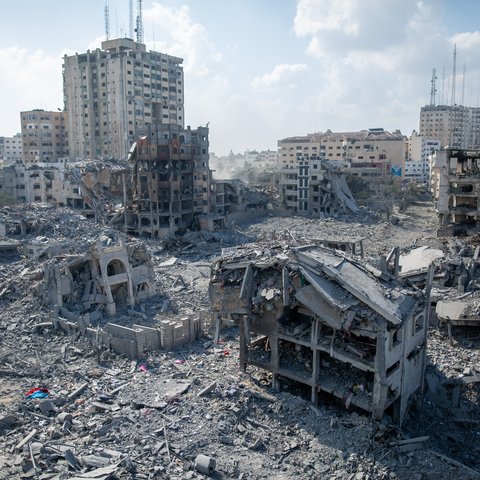
Devastation in Gaza. Photo: Fady Hanona
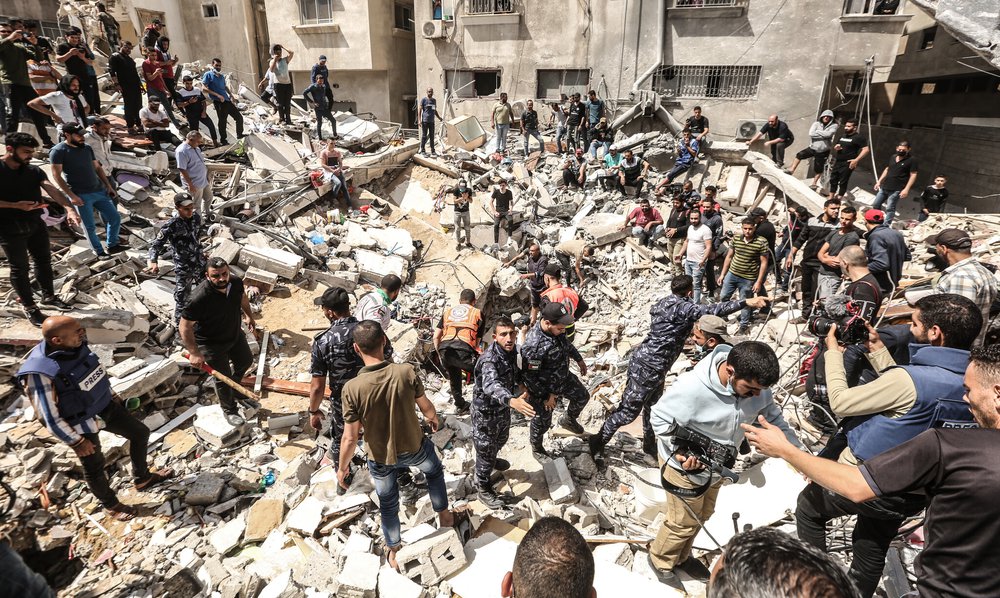
Devastation in Gaza. Photo: Fady Hanona

The $71.4 billion (£53 billion) needed to rebuild Gaza is seven times, in real terms, the combined cost of reconstruction after every major Israeli military offensive there over the past two decades, a new joint report has found. 

Even that figure captures only part of what was destroyed — the physical and economic cost — not the deliberate erasure of the social fabric that holds Gaza together, which will take generations to restore.

The UK government must take the lead in ensuring Palestinians are the primary decision-makers in rebuilding the Gaza Strip and should no longer suffer the devastating consequences of the Israeli Government’s ongoing genocide and aid blockade in Gaza. The government must show its commitment to international law by ending the sale to Isreal of arms that are used in violations of international law and banning trade and investment in illegal Israeli settlements in the occupied Palestinian territory.”

Richard Hawkes, chief executive of Oxfam GB

The report Building Gaza Anew – co-authored by Oxfam, the Palestine Economic Policy Research Institute (MAS) and the Palestine Trade Centre (PalTrade) – offers a blueprint that treats Gaza’s recovery as a matter of rights and reparations, not charity. Built on extensive consultations across Gaza, it sets out for the US-chaired Board of Peace and world leaders how a reconstruction Palestinians lead can succeed – and warns that any model imposed from outside will fail, however much money sits behind it. 

Oxfam analysis of successive World Bank, EU and UN assessments shows the scale of the rupture: recovery needs after the 2008-09, 2014 and 2021 wars were around $10 billion in today’s money. Each reconstruction was strangled by blockade, access restrictions and donor shortfalls, then destroyed by the following war before it was finished.

  • According to the UN-EU-World Bank Rapid Damage and Needs Assessment (RDNA) of April 2026, Gaza has suffered $57.9 billion in total damage and economic losses, with $71.4 billion required for recovery and reconstruction over the next decade. 
  • More than 73,000 Palestinians have been killed, 173,000 injured, 1.9 million forcibly displaced, and human development set back an estimated 77 years.
  • In September 2025, the UN Independent International Commission of Inquiry concluded that Israel has committed genocide in Gaza. The report argues that governments which armed, funded or shielded the destruction share responsibility for its repair. 

Distribution of hygiene kits in the Gaza Strip as part of the emergency response. Image: Palestinian Environment Friends (PEF)/ Oxfam
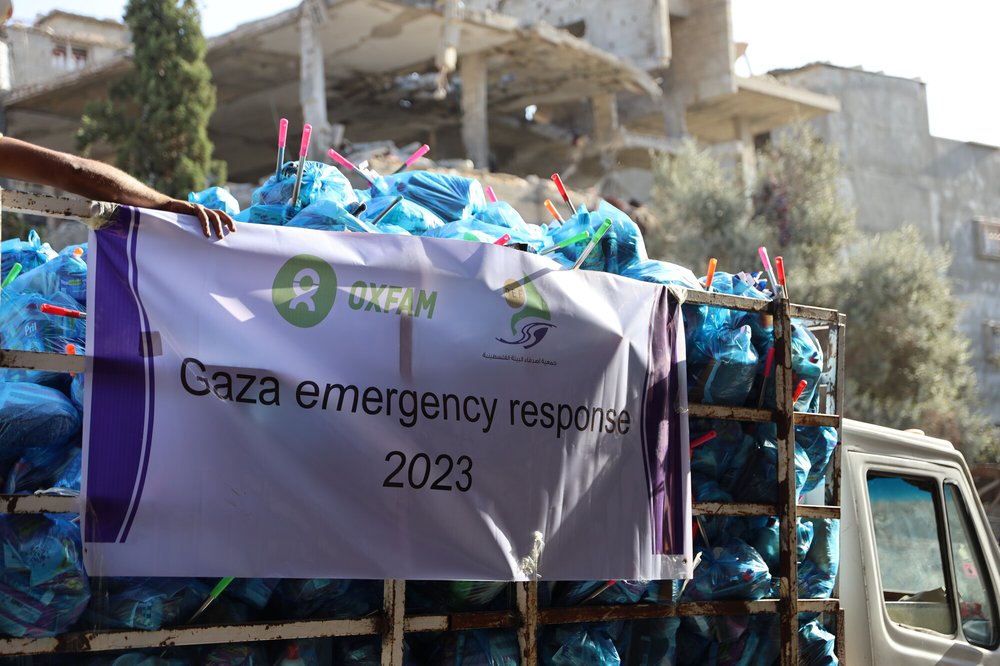
A truck with hygiene kits on the back in the streets of the bombed Gaza Strip

The report documents how the war has erased what no damage assessment can calculate – Gaza’s knowledge, care systems, environment, and the community bonds, mosques, churches, libraries, and cultural institutions where social life once lived:

  • Knowledge and memory erased: nearly all schools are destroyed or damaged, universities levelled, thousands of teachers, professors and researchers have been killed, and libraries and archives of Palestinian history lost.
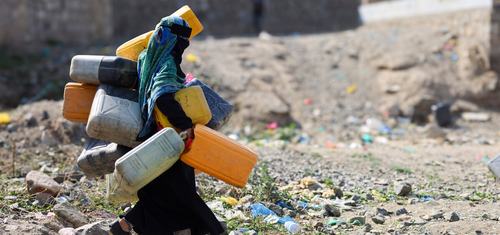
  • A care system collapsed onto women: around 58,600 households are now headed by women while female unemployment stands at 92 per cent. Oxfam’s latest care research finds most women spend 8 to 12 hours a day – some up to 16 – on unpaid care: queuing from 5am to fill 20 litres of water, cooking single meals for hours over firewood or burning rubbish, and nursing the injured.
  • Broken bodies and stripped dignity: around one in four injuries is life-changing, more than 50,000 people need long-term rehabilitation, and an estimated 83 per cent of people with disabilities were forced to abandon their assistive devices. Many have been living in tents or shelters built for 2,000 that at times held 20,000, with as many as 650 people sharing a single toilet.
  • A land poisoned: orchards that took decades to grow, greenhouses and topsoil have been destroyed; farmland contaminated with heavy metals and explosive residue; the coastal aquifer is collapsing; and raw sewage is flowing into the sea, bringing back once-eradicated diseases including polio.

What was destroyed in Gaza was not merely steel and concrete. Israel eradicated an entire social and economic world, built up over generations, and only Palestinians can rebuild it,”

Mohammad Skaik, Gaza Program Manager, PalTrade

Marwas Sawaf / OXFAM

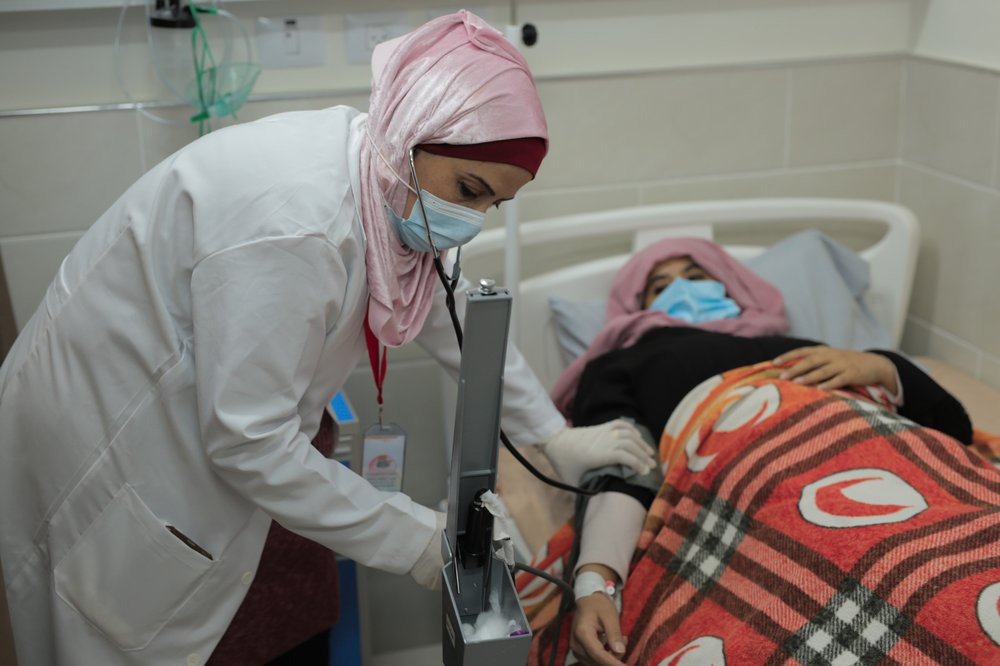
Nurse Heba Shalan is wearing a facemask and stethoscope and bending over a patient in a hospital bed who also wears a mask

Reconstruction is not only a humanitarian task; it is a political one. A plan designed in foreign capitals, however well-funded, would be a cosmetic exercise – simply another form of control over Palestinian land and lives. Our consultations across Gaza carried one unmistakable message: nothing about our future without us”

Misyef Jamil, Senior Researcher at MAS

The report sets out a five-year framework for recovery and rebuilding grounded in Palestinian ownership at every stage, underpinned by rights-based principles and a single national vision linking Gaza, the West Bank and East Jerusalem. It rejects externally imposed models that sideline Palestinian agency or fragment Palestinian territory, including any international trusteeship over Gaza, and calls for coordination with the EU, Egypt, Arab Gulf states, the UN and international agencies, anchored in international law and protected from profit-driven models of recovery.

Ahead of the 81st session of the UN General Assembly and upcoming donor talks, the report sets a clear test for the Board of Peace and every government funding Gaza’s recovery: transfer real decision-making power to Palestinians, dismantle the blockade and restrictions that have strangled every previous reconstruction, guarantee accountability for Israel’s genocide, and commit to a political horizon that ends the occupation and delivers the Palestinian self-determination owed for decades. 

Press contact

For comments, interviews, or information please contact the Oxfam GB Media Team: