Oxfam

Lots of front covers of the Disaster Divide report

How climate chaos deepens inequality and enriches the few

A headshot of Abby Mason

Abby Mason

27 Oct, 2026 / 4 mins read time

Every year Oxfam explores the status of climate inequality globally. Our report published in October 2026 makes the overlap between the inequality and climate crises clearer than ever.

What is the latest report?

Our previous research has focused on the stark evidence that the super-rich bear the greatest share of responsibility for causing the climate crisis. This is because of their massive emissions, driven by a lavish lifestyle and heavy investments in polluting industries.

Our latest report, Disaster Divide: How climate chaos deepens inequality and enriches the few, goes further. This year we’ve focused on the vastly different ways in which people experience and recover from the consequences of climate change.

We show that while the super-rich can buy protection from floods, fires and famine, the global majority is left to survive with shrinking resources. Some wealthy investors are even profiting both from the industries driving climate breakdown and from the businesses involved in disaster preparation and recovery.

Published ahead of the COP31 global climate talks in Türkiye, the report calls for climate action that puts the global majority first, particularly those who have contributed least to the crisis but are already experiencing its most devastating effects.

Key points

  • A person from the richest 0.1% has contributed x125 more than the average person to extreme heat events ... almost x400 more than someone from the poorest 50%.
  • The global disaster recovery market is forecast to grow from US$70bn to US$92bn a year by 2029, increasingly fuelled by climate-related extreme weather events.
  • Between 2014 and 2050, 1 billion people – around 10% of the world’s population – will have been displaced by the climate crisis. And most of those displaced will be in the Global South.

Disaster Divide: How climate chaos deepens inequality and enriches the few

Discover more about the overlap between the inequality and climate crises.

Read the report

What does disaster divide mean?

The disaster divide is the growing gulf between those who can protect themselves from climate breakdown and those who cannot.

Inequality is turning extreme weather events, such as floods, wildfires, cyclones and droughts, into climate disasters. This injustice begins with responsibility for the emissions driving climate change.

In just one year, emissions by the richest 1% will cause 1.9 million excess heat-related deaths.

Oxfam
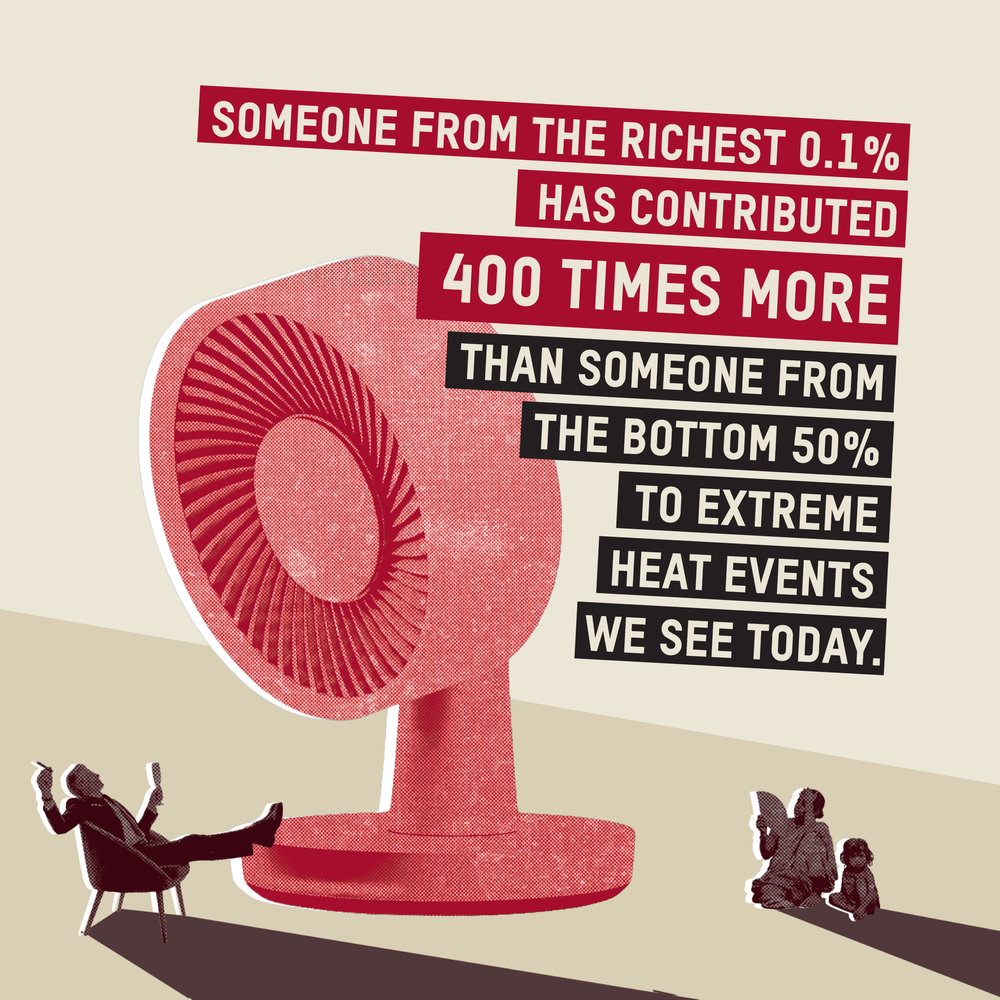
A statistic written over a graphic: Someone from the richest 0.1% has contributed 400 times more that someone from the bottom 50% to extreme heat events

The world’s richest 0.1% have contributed 125 times more than the average person to extreme heat events and almost 400 times more than someone from the world’s poorest 50%. Just one year of emissions by the wealthiest 1% of the population will cause almost 2 million excess heat-related deaths worldwide.

But the disaster divide doesn’t stop there. Our report shows wealth can also buy protection from the consequences of the climate crisis.

The wealthiest can insulate themselves from extreme weather events. They can not only buy safer houses in more protected communities but can easily absorb increases in the costs of food and water caused by the climate crisis.

At the most extreme end, billionaires can even buy islands and build underground bunkers. In places affected by wildfires, some wealthy residents have been able to hire private firefighters and evacuate in helicopters to 5-star hotels.

But the poorest people cannot cope in the same way.

For people already living in poverty, each flood, drought, wildfire or heatwave can strip away more of the limited resources they have. This makes them more exposed and more vulnerable. Livelihoods are lost and homes damaged or destroyed. Many are forced to take out loans, and some even end up on the street and displaced.

Ordinary people, hit by successive climate shocks, struggle to recover and fall deeper into poverty. Climate disasters are, in the words of the report, “inequality machines”.

This is the disaster divide: a vicious cycle in which inequality creates the conditions for climate disasters, and those disasters in turn deepen inequality.

Who is profiting from climate chaos?

The report also reveals another disturbing dimension of the disaster divide: some extremely wealthy investors are profiting both from the industries driving climate change and by investing in industries that rebuild after disaster strikes.

Our new Destroy and Rebuild Index examines 217 companies involved in industries that either contribute to climate breakdown or prepare for and respond to its consequences.

Some wealthy people profit twice: first from investing in the polluting industries that cause the crisis, then from investing in the clean-up and reconstruction industries that rebuild afterwards, often at the expense of the poorest.

While ordinary people struggle to recover from one climate shock after another, climate chaos is becoming a lucrative market for some of the world’s wealthiest people.

The numbers behind the disaster divide

The richest 0.1% (8m people)

globally emit more than the world’s poorest 44% (3.5bn people) combined.

The richest 1%

are responsible for 20% of global warming since 1990.

On average $1.8bn in profit

was made by companies in the Destroy & Rebuild Index during 2025.

Disaster Divide: How climate chaos deepens inequality and enriches the few

These figures tell a clear story. Climate change is not simply an environmental crisis. It is a crisis of inequality, power and justice. Without action, the disaster divide will grow.

This is an urgent call to action

The disaster divide is not a natural or unavoidable consequence of extreme weather. It is the result of political and economic choices. Choices about:

  • who is protected
  • who pays for climate damage
  • who has access to the resources needed to prepare, adapt and recover.

It is possible to break this vicious circle. We can minimize the human harm of climate breakdown by reducing the emissions of the richest people, radically reducing inequality, and ensuring that actions to adapt to climate change have equality at their centre.

What is Oxfam doing?

Oxfam is calling on governments to:

  • Curb the excessive emissions of the super-rich, including emissions from their investments.
  • Make rich countries provide far more grant-based finance to help lower-income countries adapt.
  • Set clear, time-bound national plans to reduce economic inequality.
  • Minimize exposure, reduce vulnerability and equalize adaptation to extreme weather events to build more equal and resilient food systems.
  • End profiteering from climate-related disasters.